


Field
Investigators
Home
About
Case Archive
EVIDENCE
CASE #0018
JULY 2026
EVIDENCE 18.01
DESCRIPTION
Initial scene.
OBSERVATIONS
-The room is ornate.
-The chair is unoccupied.
-The window is the brightest element.
-Heavy curtains frame the window.
-No people are visible.
-The exterior beyond the glass is indistinct.
INITIAL QUESTIONS
-Why is the chair empty?
-What’s behind the window?
-Is the window important?
CLASSIFICATION
Clue
NOTE
Establishes the primary setting and introduces the chair and window, both of which remain central to the investigation.

18.01
EVIDENCE 18.02
DESCRIPTION
I removed the chair from the foreground.
OBSERVATIONS
-One chair remains.
-The remaining chair becomes the primary focal point.
-More of the window is visible.
-The composition feels less crowded.
INITIAL QUESTIONS
-Is the remaining chair meant to represent a specific person?
-Does the absence of the second chair create a sense of loss or expectation?
CLASSIFICATION
Clue
NOTE
Removing the second chair simplifies the composition and draws attention to the single remaining chair, increasing its narrative importance.

18.02
18.02
EVIDENCE 18.03
DESCRIPTION
The ocean replaces the exterior view.
OBSERVATION
-Large ocean wave visible beyond the window.
-Blue sky appears.
-Interior remains unchanged.
-Attention shifts toward the exterior.
INITIAL QUESTION
-Why is there an ocean outside the window?
-Is the wave the mystery?
-Is the outside world the focus of the investigation?
CLASSIFICATION
Dead End
NOTE
The investigation briefly explored the ocean as a possible mystery. This direction was later abandoned when the case evolved toward the forest setting.
EVIDENCE 18.04
DESCRIPTION
The forest replaces the walls.
OBSERVATIONS
-The ocean is gone.
-The trees and vegetation are now visible beyond the window.
-Greenery begins extending into the room on the left.
-The chair remains unchanged.
-The window continues as the central focal point.
INITIAL QUESTIONS
-Why has the ocean become a forest?
-Will the forest enter the room?
-What is the significance of the trees?
-Is the mystery connected to nature rather than the room?
CLASSIFICATION
Clue
NOTE
The investigation shifts away from the abandoned ocean theory and toward the forest, which remains central throughout the rest of the case.
EVIDENCE 18.05
DESCRIPTION
A warm golden texture is applied to the chair and curtains.
OBSERVATIONS
-The chair appears warmer and more aged.
-The curtains shift from a duller tan to a golden-brown.
-Overall, the scene feels warmer and more cohesive.
-The forest remains unchanged.
INITIAL QUESTIONS
-Does the warmer palette change the mood of the scene?
-Is the room becoming more inviting?
-Does this suggest the room and forest are beginning to belong together?
CLASSIFICATION
Clue
NOTE
This change strengthens the visual harmony between the interior and the forest, helping to establish the case’s atmosphere.
EVIDENCE 18.06
DESCRIPTION
The forest lighting and contrast are adjusted.
OBSERVATIONS
-The left side of the forest is significantly darker.
-The area through the window is brighter by contrast.
-The chair remains the primary interior object.
-Attention is drawn more strongly toward the window.
INITIAL QUESTIONS
-Why does the forest become darker away from the window?
-Is the window acting as a threshold between two worlds?
CLASSIFICATION
Clue
NOTE
The increased contrast narrows the viewer’s attention toward the window, reinforcing it as the primary point of interest.
EVIDENCE 18.07
DESCRIPTION
The curtains and chair are now a deep burgundy.
OBSERVATIONS
-The curtains shift from gold to burgundy.
-The chair upholstery takes on the same burgundy tone.
-The forest remains unchanged.
-There is a stronger color contrast between the warm interior and green exterior.
INITIAL QUESTIONS
-Why is the room becoming darker and richer in color?
-Does the burgundy palette change the mood of the scene?
-Is the interior becoming emotionally distinct from the forest?
CLASSIFICATION
Clue
NOTE
The burgundy palette becomes a defining visual characteristic of the final artwork, strengthening the atmosphere and helping separate the interior from the exterior.
EVIDENCE 18.08
DESCRIPTION
The right side foliage is darker and greener.
OBSERVATIONS
-Shadows deepen along the right edge.
-The window remains the brightest area.
-The chair becomes more visually isolated.
-Contrast between the center and edges increases.
INITIAL QUESTIONS
-Why is the room becoming more enclosed?
-Is the darkness directing attention toward the window?
-Does the right side conceal something?
CLASSIFICATION
Clue
NOTE
The darker right side creates a subtle vignette, drawing the viewer’s attention to the chair and window while intensifying the scene’s mood.
EVIDENCE 18.09
DESCRIPTION
Two teacups appear on the chair.
OBSERVATIONS
-Two teacups rest on the chair.
-Both cups appear unused.
-No people are visible.
INITIAL QUESTIONS
-Why are there two cups?
-Are two people expected?
-Have they recently left?
-Why are there two cups, but only one chair?
CLASSIFICATION
Clue
NOTE
The simultaneous appearance of two teacups immediately introduces the possibility of an unseen second person. This marks the first suggestion that the mystery involves more than the lone occupant implied by the empty chair.
EVIDENCE 18.10
DESCRIPTION
Steam rises from both cups.
OBSERVATIONS
-Steam is visible above both cups.
-The steam is actively rising.
-No person is present.
-The cups are still on the chair.
INITIAL QUESTIONS
-Who poured the tea?
-How recently was it poured?
-Where are the people who should be drinking it?
-Is someone about to arrive, or has someone just left?
CLASSIFICATION
Clue
NOTE
The rising steam suggests the tea is freshly poured, implying that whoever prepared it was present only moments before the investigation began.
EVIDENCE 18.11
DESCRIPTION
A woman in a blue gown appears.
OBSERVATIONS
-A single woman appears.
-She stands in front of an ornate stone doorway.
-She has her back to us but looks over her shoulder.
-She is not yet integrated into the room.
INITIAL QUESTIONS
-Who is she?
-Why is she looking back?
-Is she connected to the chair and the teacups?
-Does she belong inside the room or somewhere else?
CLASSIFICATION
Clue
NOTE
This is the first appearance of a human figure, shifting the investigation from an environmental mystery to one involving a specific person.
EVIDENCE 18.12
DESCRIPTION
The woman is now mostly obscured by trees.
OBSERVATIONS
-A partial human figure is visible in the distance.
-Trees mostly obscure her.
-The chair and teacups remain unchanged.
-The figure is difficult to distinguish.
INITIAL QUESTIONS
-Is someone hiding in the forest?
-Is she watching the room?
-Is she important to the mystery?
-Why is she so hidden?
CLASSIFICATION
Red herring
NOTE
The partially hidden figure briefly redirected the investigation toward the forest. This approach was later abandoned in favor of a more direct relationship between the two women.


18.03
18.04
18.05
18.06

18.07

18.08

18.09

18.10

18.11

18.12
EVIDENCE 18.13
DESCRIPTION
The woman becomes fully visible outside the window.
OBSERVATIONS
-The woman stands outside the window.
-She looks back over her shoulder.
-The lower half of her dress blends into the surrounding foliage.
-She appears connected to the forest.
-The chair and teacups remain unchanged.
INITIAL QUESTIONS
-Why is she outside and not inside?
-Is she becoming part of the forest?
-Is she leaving, arriving, or simply watching?
-Is she connected to the empty chair?
CLASSIFICATION
Clue
NOTE
The woman becomes a central figure in the investigation. Her dress merging with the foliage suggests a connection between her and the forest, deepening the mystery surrounding her role.
EVIDENCE 18.14
DESCRIPTION
The woman and the surrounding foliage are refined.
OBSERVATIONS
-The woman’s dress changes from blue to cream.
-Green foliage overlays the lower portion of her dress.
-Tree branches around her become more delicate and intricate.
-The woman remains outside the window.
INITIAL QUESTIONS
-Is she becoming part of the forest?
-Why has her dress changed color?
-Are the branches concealing or embracing her?
-Is nature transforming her?
CLASSIFICATION
Clue
NOTE
The woman becomes more integrated with the forest. The lighter dress and delicate branches strengthen the impression that she belongs to the natural world rather than standing apart from it.
EVIDENCE 18.15
DESCRIPTION
Composition has zoomed in.
OBSERVATIONS
-The chair occupies more of the frame.
-The woman appears larger.
-The window becomes more prominent.
-Less of the surrounding forest is visible.
INITIAL QUESTIONS
-Why has the focus narrowed?
-Is the relationship between the chair and the woman becoming more important?
-Which details are now meant to be noticed?
CLASSIFICATION
Clue
NOTE
The tighter composition shifts attention away from the broader environment and toward the relationship between the empty chair, the teacups, and the woman outside.
EVIDENCE 18.16
DESCRIPTION
Painterly texture and warm color grading applied.
OBSERVATIONS
-Painterly texture appears across the composition.
-Overall color shifts toward warmer gold tones.
-Fine surface texture becomes visible on the curtains and chair.
-The composition feels more unified.
INITIAL QUESTIONS
-Is the scene becoming more memory-like than realistic?
-Does the warmer palette change the emotional tone?
-Is the room and forest becoming part of the same world?
CLASSIFICATION
Clue
NOTE
The painterly treatment unifies the scene, blurring distinctions among elements and strengthening the dreamlike atmosphere.
EVIDENCE 18.17
DESCRIPTION
A staircase is introduced in the forest.
OBSERVATIONS
-A staircase and hallway appear on the left side.
-The original forest is partially obscured.
-The chair, teacups, and woman remain unchanged.
-The staircase becomes a prominent visual element.
INITIAL QUESTIONS
-Does the staircase connect to the room?
-Is someone expected to enter from this hallway?
-Does the staircase explain the mystery?
-Is this a second location?
CLASSIFICATION
Red Herring
NOTE
The staircase briefly suggested an alternate direction for the investigation, but was ultimately removed because it introduced a separate mystery rather than strengthening the existing one.
EVIDENCE 18.18
DESCRIPTION
The staircase is more integrated into the forest.
OBSERVATIONS
-Trees partially surround the staircase.
-Vegetation overlaps portions of the structure.
-The staircase appears less isolated than before.
-Blending remains incomplete.
INITIAL QUESTIONS
-Is the staircase hidden within the forest?
-Does it lead somewhere important?
-Is it connected to the woman or the room?
CLASSIFICATION
Red Herring
NOTE
The staircase became more believable as part of the forest, but continued to pull the investigation away from the central mystery. It was later removed.
EVIDENCE 18.19
DESCRIPTION
A large tree is introduced into the foreground.
OBSERVATIONS
-The tree visually connects the room and the forest.
-The staircase remains in the scene.
-The woman remains unchanged.
INITIAL QUESTIONS
-Is the tree significant?
-Does it connect the interior and exterior?
-Is it concealing something?
-Is the tree more important than the chair?
CLASSIFICATION
Red Herring
NOTE
The foreground tree briefly suggested a stronger connection between the room and the forest, but ultimately distracted from the central relationship between the chair and the woman. It was later removed.
EVIDENCE 18.20
DESCRIPTION
The staircase is no longer at the scene.
OBSERVATIONS
-The staircase is no longer visible.
-The large foreground tree remains.
-The left side of the forest is darker.
-The chair, teacups, and woman remain unchanged.
INITIAL QUESTIONS
-Does removing the staircase strengthen the mystery?
-Is the forest alone a better setting?
-Was the staircase unnecessary?
CLASSIFICATION
Red Herring
NOTE
The removal of the staircase marks the end of an investigative path that failed to support the central mystery. The forest remained, but the separate staircase narrative was abandoned.
EVIDENCE 18.21
DESCRIPTION
A second foreground tree is introduced.
OBSERVATIONS
-A second large tree appears on the left side.
-The left side of the forest becomes denser.
-The chair remains partially obscured.
-The woman and teacups remain unchanged.
INITIAL QUESTIONS
-Is the forest becoming the focus?
-Do the trees conceal something important?
-Are the trees meant to connect the room and the forest?
CLASSIFICATION
Red Herring
NOTE
The additional tree increased the forest’s visual weight but did not deepen the central mystery. This direction was later abandoned.
EVIDENCE 18.22
DESCRIPTION
The staircase was reintroduced within the forest.
OBSERVATIONS
-The staircase reappears on the left side.
-It is more naturally integrated into the surrounding trees.
-The forest partially conceals the structure.
-The chair, teacups, and woman remain unchanged.
INITIAL QUESTIONS
-Is the staircase now important?
-Does it lead to the room?
-Is it another threshold?
-Does better integration make it part of the solution?
CLASSIFICATION
Red Herring
NOTE
The improved blending made the staircase feel more believable within the forest, but it still introduced a separate mystery. It was ultimately removed from the final composition.
EVIDENCE 18.23
DESCRIPTION
The forest further conceals the staircase.
OBSERVATIONS
-The staircase is less visible than before.
-An additional tree appears on the left side.
-The forest becomes denser.
-The chair, teacups, and woman remain unchanged.
INITIAL QUESTIONS
-Is the staircase meant to be discovered?
-Are the trees hiding an important clue?
-Is the forest becoming the primary setting?
CLASSIFICATION
Red Herring
NOTE
Increasing the forest density made the staircase more subtle, but it continued to introduce a competing mystery and was ultimately abandoned.
EVIDENCE 18.24
DESCRIPTION
Additional foreground trees added.
OBSERVATIONS
-A new tree appears on the right side.
-Another tree is added to the left side.
-The forest becomes more enclosed around the scene.
-The staircase remains partially visible.
INITIAL QUESTIONS
-Is the forest itself the mystery?
-Are the trees meant to frame or conceal something?
-Does the denser forest improve the composition?
CLASSIFICATION
Red Herring
NOTE
The increasing number of foreground trees shifted attention toward the forest as the primary subject. This direction was later abandoned in favor of a simpler composition focused on the woman, chair, and window.

18.13
18.14


18.15

18.16

18.17

18.18

18.19

18.20

18.21

18.22
18.23

18.24
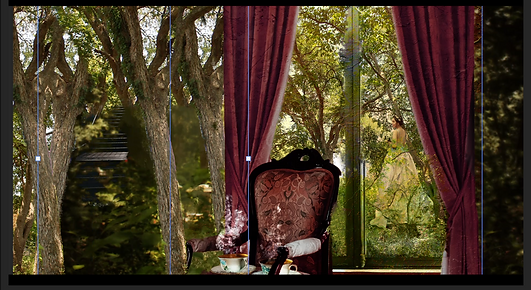
EVIDENCE 18.25
DESCRIPTION
Composition zoomed in.
OBSERVATIONS
-The camera is closer to the chair and the woman.
-The additional foreground trees remain.
-The staircase is still partially visible.
-The chair and teacups occupy more of the frame.
INITIAL QUESTIONS
-Does a tighter composition strengthen the mystery?
-Is the forest still distracting?
-Should the focus remain on the chair and the woman?
CLASSIFICATION
Red Herring
NOTE
Zooming in improved the composition, but the forest and staircase continued to compete with the central mystery. The investigative focus had not yet narrowed to the essential elements.
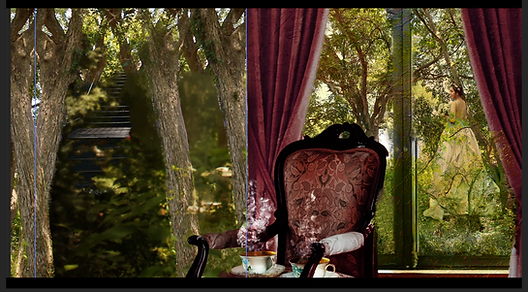
EVIDENCE 18.26
DESCRIPTION
Composition reframed with a tighter crop.
OBSERVATIONS
-The chair becomes more prominent.
-The woman is framed more clearly by the curtains.
-The window occupies more of the composition.
-The overall framing closely matches the final artwork.
INITIAL QUESTIONS
–Does this framing better reveal the mystery?
-Is the relationship between the chair and the woman becoming clearer?
-Does the tighter composition improve the investigation?
CLASSIFICATION
Clue
NOTE
This reframing establishes the composition that largely carries through to the final artwork. It shifts attention toward the relationship between the chair, the window, and the woman, strengthening the central mystery.
EVIDENCE 18.27
DESCRIPTION
The left side of the composition darkened.
OBSERVATIONS
-Shadows deepen throughout the left forest.
-The contrast between the left and right sides increases.
-The woman remains the brightest focal point.
-The chair and teacups are unchanged.
INITIAL QUESTIONS
-Does the darker forest strengthen the mood?
-Does increased contrast draw the eye toward the woman?
-Is the left side becoming background rather than subject?
CLASSIFICATION
Clue
NOTE
Darkening the left side reduces visual competition and directs attention toward the chair, window, and woman. This refinement strengthens the final composition without introducing new narrative elements.
EVIDENCE 18.28
DESCRIPTION
The left foreground tree is lit.
OBSERVATIONS
-The far-left tree becomes lighter.
-A dark opening toward the staircase becomes more pronounced.
-The staircase appears framed by shadow.
-The rest of the composition remains largely unchanged.
INITIAL QUESTIONS
-Is the dark opening a doorway?
-Is the staircase hidden within the forest?
–Is the viewer meant to enter the forest?
-Is the staircase the real mystery?
CLASSIFICATION
Red Herring
NOTE
Lightening the foreground tree unintentionally emphasized the dark passage leading toward the staircase, creating a compelling but competing mystery. This direction was later abandoned in favor of the relationship between the chair and the woman.
EVIDENCE 18.29
DESCRIPTION
Far-left tree darkened.
OBSERVATIONS
-The far-left tree is significantly darker.
-The left edge recedes into shadow.
-The staircase becomes less visually dominant.
-The woman remains the most interesting point.
INITIAL QUESTIONS
-Does the darker edge reduce distractions?
-Is the viewer’s attention now returning to the chair and the woman?
-Is the staircase becoming secondary?
CLASSIFICATION
Clue
NOTE
Darkening the far-left tree suppresses the visual pull of the staircase and keeps the viewer’s attention on the central relationship between the chair, window, and woman. This refinement supports the final composition.
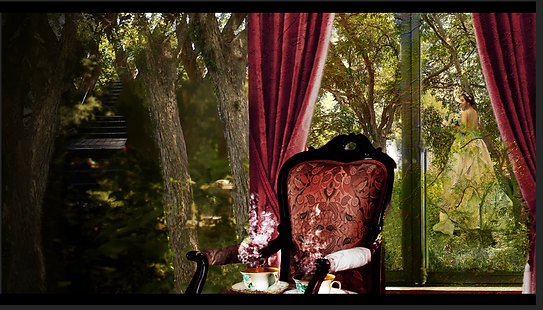
EVIDENCE 18.30
DESCRIPTION
The contrast and color intensity increased in the curtains and chair.
OBSERVATIONS
-The chair becomes more saturated.
-The curtains become more vibrant.
-Overall contrast increases.
-The woman remains the primary focal point.
INITIAL QUESTIONS
-Does stronger contrast improve readability?
-Is the increased color helping or distracting?
-Which adjustments should remain?
CLASSIFICATION
Clue
NOTE
Increasing contrast improved the visual hierarchy and strengthened the composition. Although the added color saturation was later reduced, the contrast adjustment remained an important step toward the final artwork.
EVIDENCE 18.31
DESCRIPTION
The left side of the forest blurred.
OBSERVATIONS
-The left forest becomes significantly softer.
-The staircase is more obscured.
-The chair, woman, and window remain unchanged.
-The blur increases the sense of depth.
INITIAL QUESTIONS
-Does the blur improve the composition?
-Does obscuring the forest strengthen the mystery?
-Is the staircase still drawing too much attention?
CLASSIFICATION
Red Herring
NOTE
Blurring the left side helped push the forest into the background, but the composition still centered on the staircase narrative. This approach was later abandoned in favor of simplifying the left side altogether.
EVIDENCE 18.32
DESCRIPTION
Composition simplified by returning to an earlier arrangement.
OBSERVATIONS
-The additional foreground trees are gone.
-The staircase is no longer visible.
-The composition resembles an earlier version.
-The chair, woman, and window become the dominant elements again.
INITIAL QUESTIONS
-Was the investigation becoming overcomplicated?
-Is a simpler composition stronger?
-Should the mystery center on the woman rather than the forest?
CLASSIFICATION
Clue
NOTE
The investigation intentionally backtracked to a simpler composition after several unsuccessful experiments. Removing the competing elements in the forest clarified the central relationship among the chair, the window, and the woman, moving the case closer to its final resolution.
EVIDENCE 18.33
DESCRIPTION
Vignette added.
OBSERVATIONS
-The edges of the composition are darker.
-Attention is drawn toward the center.
-The woman, chair, and window become more visually prominent.
-No objects are added or removed.
INITIAL QUESTIONS
-Does the vignette improve focus?
-Does it strengthen the mood?
-Is the viewer’s attention better directed toward the mystery?
CLASSIFICATION
Clue
NOTE
The vignette strengthens the composition by reducing distractions along the edges and concentrating attention on the central relationship between the chair, the window, and the woman. It remains part of the final artwork.
EVIDENCE 18.34
DESCRIPTION
The second woman is introduced inside the room.
OBSERVATIONS
-A second woman appears on the right side.
-She is much larger than the woman outside.
-She faces toward the window.
-The original woman remains outside.
INITIAL QUESTIONS
-Are these two different women?
-Is the indoor woman watching the outdoor woman?
-Are they the same person at different moments?
-Which woman is the main character?
CLASSIFICATION
Red Herring
NOTE
The introduction of a second woman shifted the investigation toward questions of identity and duality. Although intriguing, it created a competing narrative and was later removed to preserve a single, clearer mystery.
EVIDENCE 18.35
DESCRIPTION
Indoor woman enlarged and moved into the foreground.
OBSERVATIONS
-Only the blue dress is now visible.
-The figure occupies the right edge of the composition.
-The outdoor woman remains unchanged.
-The foreground figure partially blocks the scene.
INITIAL QUESTIONS
-Is the foreground figure the observer?
-Are the two women connected?
-Does the foreground figure improve the mystery?
-Is she obscuring the true subject?
CLASSIFICATION
Red Herring
NOTE
Enlarging the indoor figure increased the sense of a hidden observer, but it continued to create a second narrative that distracted from the central mystery. This direction was later abandoned.
EVIDENCE 18.36
DESCRIPTION
Foreground dress desaturated.
OBSERVATIONS
-The blue dress changes to grayscale.
-The foreground figure remains on the right edge.
-The outdoor woman remains unchanged.
-The composition is otherwise unchanged.
INITIAL QUESTIONS
-Does removing the color make the foreground figure less distracting?
-Is the foreground figure still necessary?
-Should the viewer focus on the woman outside instead?
CLASSIFICATION
Red Herring
NOTE
Desaturating the foreground figure reduced its visual dominance, but it still introduced a competing narrative. The figure was ultimately removed from the final composition.
EVIDENCE 18.37
DESCRIPTION
Foreground dress recolored to match the room.
OBSERVATIONS
-The foreground dress changes from gray to burgundy.
-Its color now closely matches the chair and curtains.
-The outdoor woman remains unchanged.
-The foreground figure continues to occupy the right edge.
INITIAL QUESTIONS
-Does matching the room’s colors integrate the figure?
-Is the foreground figure part of the room?
-Does the color harmony justify keeping her?
-Is she still distracting from the central mystery?
CLASSIFICATION
Red Herring
NOTE
Recoloring the foreground figure visually integrated her with the room, but she continued to create a competing narrative. Although it fit the palette better, the figure was ultimately removed from the final composition.
EVIDENCE 18.38
DESCRIPTION
Foreground dress desaturated.
OBSERVATIONS
-The burgundy dress becomes less saturated.
-The foreground figure remains on the right edge.
-The woman outside remains unchanged.
-The overall composition is otherwise unchanged.
INITIAL QUESTIONS
-Does reducing the color make the foreground figure less distracting?
-Can the figure be retained without competing for attention?
-Is the figure still necessary?
CLASSIFICATION
Red Herring
NOTE
Desaturating the foreground figure reduced its visual weight but failed to resolve the competing narrative it introduced. The figure was ultimately removed from the final composition.

18.25
18.26

18.27

18.28

18.29
18.30

18.31

18.32

18.33

18.34

18.35

18.36

18.37

18.38
EVIDENCE 18.39
DESCRIPTION
The foreground woman reappears on the right.
OBSERVATIONS
A woman’s upper body appears at the far right edge.
The blue skirt remains.
She partially overlaps the curtain.
The outdoor woman remains unchanged.
INITIAL QUESTIONS
Is the woman inside connected to the woman outside?
Is she observing the scene?
Does the mystery require two women?
CLASSIFICATION
Red Herring
NOTE
The foreground woman briefly returns as a possible second character, but she is ultimately removed. Her presence distracted from the central mystery rather than clarifying it.
EVIDENCE 18.40
DESCRIPTION
The foreground skirt changes from blue to teal.
OBSERVATIONS
-The skirt shifts to a teal color.
-It contrasts more strongly against the burgundy curtain.
-The foreground woman remains only partially visible.
-The outdoor woman is unchanged.
INITIAL QUESTIONS
-Does the color change distinguish the two women?
-Is the foreground woman meant to become more important?
-Why emphasize the contrast?
CLASSIFICATION
Red Herring
NOTE
The color change makes the foreground figure stand out more, briefly increasing her visual importance. She is ultimately removed from the final artwork, making this another abandoned direction.
EVIDENCE 18.41
DESCRIPTION
An oil-painted texture is applied across the composition.
OBSERVATIONS
-Brushstroke-like textures appear throughout the image.
-The forest, chair, curtains, and woman all become more painterly.
-Edges soften while forms remain recognizable.
-The surreal quality increases.
INITIAL QUESTIONS
-Does the painterly finish make the scene feel more dreamlike?
-Does the loss of photographic realism help the mystery?
-Is this the intended visual language of the final piece?
CLASSIFICATION
Clue
NOTE
This establishes the painterly aesthetic that carries through to the finished artwork, shifting the investigation from photographic collage toward a unified surreal painting.
EVIDENCE 18.42
DESCRIPTION
The foreground dress darkens and gains contrast.
OBSERVATIONS
-The teal dress becomes darker.
-Contrast and shadows increase.
-The woman remains cropped at the edge of the frame.
-The outdoor scene is unchanged.
INITIAL QUESTIONS
-Is the foreground woman becoming a central character?
-Why emphasize her clothing?
-Will she remain in the final composition?
CLASSIFICATION
Red Herring
NOTE
The darker dress briefly gives the foreground figure more visual weight, but she is ultimately removed from the final artwork, making this another discarded direction.
EVIDENCE 18.43
DESCRIPTION
The foreground dress shifts from teal to dark gray.
OBSERVATIONS
-The dress loses its teal color.
-It becomes darker and more neutral.
-The foreground figure remains partially visible.
-The rest of the composition is essentially unchanged.
INITIAL QUESTIONS
-Is the foreground woman meant to disappear into the shadows?
-Does removing the color make her less significant?
-Will this figure remain in the final piece?
CLASSIFICATION
Red Herring
NOTE
The desaturated dress reduces the figure’s visual prominence, but the entire foreground woman is ultimately removed from the final artwork, making this another abandoned investigative path.
EVIDENCE 18.44
DESCRIPTION
Overall contrast is adjusted across the composition.
OBSERVATIONS
-Blacks become deeper.
-Highlights become brighter.
-The chair, curtains, and forest gain stronger separation.
-The woman’s silhouette is more defined.
INITIAL QUESTIONS
-Does the increased contrast better direct the viewer’s eye?
-Which elements are intended to become the focal points?
-Is the composition nearing its final tonal balance?
CLASSIFICATION
Clue
NOTE
This tonal adjustment strengthens the visual hierarchy and brings the composition closer to its final appearance by emphasizing the key subjects without changing the underlying narrative.
EVIDENCE 18.45
DESCRIPTION
The composition is cropped tighter, and the left side is extended.
OBSERVATIONS
-The framing is significantly tighter.
-The left forest is expanded to fill the frame.
-The chair and teacups become more prominent.
-The woman outside is pushed closer to the right edge.
-The extension on the left is still visibly unblended.
INITIAL QUESTIONS
-Does this framing create the intended visual balance?
-Does the tighter crop strengthen the mystery?
-Has the final composition been found?
CLASSIFICATION
Breakthrough
NOTE
This is the first version that establishes the final composition. Although the left-side extension still requires refinement, the overall framing is no longer exploratory and becomes the foundation for the finished artwork.
EVIDENCE 18.46
DESCRIPTION
The left-side forest extension is blended into the composition.
OBSERVATIONS
-The seam on the left side is no longer visible.
-The forest appears continuous.
-The overall composition feels more cohesive.
-No major subject matter changes.
INITIAL QUESTIONS
-Does the seamless forest make the scene more believable?
-Has the composition reached its intended structure?
CLASSIFICATION
Clue
NOTE
The successful blending of the extended forest removes a visible distraction and completes the composition established in the previous breakthrough, making the expanded scene feel natural and intentional.
EVIDENCE 18.47
DESCRIPTION
The left side of the forest is refined with additional depth and lighting.
OBSERVATIONS
-Light penetrates farther into the forest.
-Foreground and background are more clearly separated.
-The left side feels deeper and less flat.
-The composition becomes more immersive.
INITIAL QUESTIONS
-Does the increased depth better balance the window scene?
-Is the forest becoming a destination rather than just a backdrop?
CLASSIFICATION
Clue
NOTE
Refining the forest’s depth and lighting strengthens the illusion of a real, explorable space, reinforcing its role as an important counterpart to the woman outside the window.
EVIDENCE 18.48
DESCRIPTION
Additional foliage is integrated into the composition.
OBSERVATIONS
-New foliage appears along the left edge.
-Branches and leaves extend over the woman’s dress.
-The woman becomes more visually connected to the surrounding forest.
-The left side gains additional foreground detail.
INITIAL QUESTIONS
-Is the forest beginning to reclaim the woman?
-Are the branches intentionally obscuring her?
-Does this strengthen the woman’s relationship with nature?
CLASSIFICATION
Clue
NOTE
The added foliage further unifies the woman with the forest, suggesting she is becoming part of the landscape rather than simply standing within it. It also increases the composition’s visual depth.
EVIDENCE 18.49
DESCRIPTION
Additional highlights and foliage are added throughout the forest.
OBSERVATIONS
-Bright yellow-green highlights appear in the left forest.
-Similar highlights are added around the woman.
-The canopy feels brighter and more luminous.
-The woman becomes more integrated into the illuminated foliage.
INITIAL QUESTIONS
-Is the forest becoming an active presence rather than a backdrop?
-Are the highlights directing attention toward the woman?
-Does the brighter foliage reinforce the transformation taking place?
CLASSIFICATION
Clue
NOTE
The added highlights unify the lighting across the composition and strengthen the connection between the woman and the surrounding forest, making the environment feel more alive and intentional.
EVIDENCE 18.50
DESCRIPTION
Final refinements are made to lighting and painterly texture.
OBSERVATIONS
Contrast is slightly more balanced.
The chair, curtains, and forest appear more unified.
The woman blends more naturally into the surrounding foliage.
The image is visually very close to the finished artwork.
INITIAL QUESTIONS
Has the intended atmosphere been achieved?
Is the composition ready for completion?
CLASSIFICATION
NOTE
This evidence represents the final stage of refinement before completion. Rather than introducing new ideas, it unifies the existing elements into the nearly finished composition.
EVIDENCE 18.51
DESCRIPTION
Final artwork completed.
OBSERVATIONS
The composition is fully resolved.
The foreground woman has been removed.
The staircase has been removed.
The empty chair remains.
Two steaming teacups remain.
A woman stands outside the window.
Her dress merges with the surrounding foliage.
Painterly texture unifies the entire image.
INITIAL QUESTIONS
Why is she outside instead of inside?
Who drank from the second teacup?
Is she leaving... or becoming part of the forest?
CLASSIFICATION
Breakthrough
NOTE
The investigation concludes with the removal of all unnecessary elements. What remains is the essential mystery: an empty chair, evidence of two unseen occupants, and a woman who appears to be dissolving into the natural world. The final composition answers earlier questions by subtraction rather than addition

18.39

18.40

18.41

18.42

18.43

18.44

18.45

18.46

18.47

18.48

18.49

18.50
