


Field
Investigators
Home
About
Case Archive


EVIDENCE 19.01 - clue

EVIDENCE 19.01
DESCRIPTION
The investigation begins with a bright interior featuring a large arched window, a vintage sofa, and a potted plant. No people, insects, or landscapes beyond the window have been introduced yet.
OBSERVATIONS
-The room is flooded with natural light.
-The arched window immediately becomes the dominant architectural feature.
-The sofa anchors the composition in the lower center.
-The plant adds the only organic element inside the room.
-The view beyond the window is obscured by textured glass, leaving the outside world unknown.
-The overall atmosphere feels calm, clean, and ordinary.
INITIAL QUESTIONS
-What lies beyond the window?
-Why is the room empty?
-Is someone expected to arrive?
-Will the investigation remain inside this room, or extend beyond it?
-Is the sofa meant to be occupied, or simply observed?
CLASSIFICATION
Clue
NOTE
This is the establishing scene for Case #0019. At this stage, there is no obvious mystery beyond the unanswered questions created by the empty room itself. The composition provides the architectural framework for the rest of the investigation.

EVIDENCE 19.02 - clue

EVIDENCE 19.02
DESCRIPTION
Large textured watercolor panels have been placed over both the left and right sides of the composition, narrowing the visible scene to the center of the room. The sofa, arched window, and plant remain unchanged.
OBSERVATIONS
-The side walls are now concealed beneath aged paper watercolor textures.
-The composition feels more enclosed and intentional.
-Warm tan and cream tones begin to establish the palette of the investigation.
-The eye is guided more directly toward the window and sofa.
-The textured paper introduces a handcrafted, collage-like quality that was absent in the previous evidence.
INITIAL QUESTIONS
-Will these paper textures become architectural walls or simply a background?
-Why is the room being visually narrowed?
-Is the investigation shifting from a modern interior to an older structure?
-What details will eventually replace or emerge from these textured areas?
CLASSIFICATION
Clue
NOTE
This evidence marks the first clear departure from the source photograph. Rather than adding new subjects, the investigation begins transforming the environment itself, suggesting the room is being reconstructed rather than merely decorated.

EVIDENCE 19.03 - clue

EVIDENCE 19.03
DESCRIPTION
The bright window has been replaced with a dramatic view of a mountain valley through the archway. The paper textures have evolved into aged architectural walls with exposed plaster and masonry, transforming the modern room into a weathered stone interior.
OBSERVATIONS
-The outside world is revealed for the first time.
-The mountain pass creates strong depth and atmospheric perspective.
-The room immediately feels older and more abandoned.
-The archway now functions as a portal rather than simply a window.
-The warm interior contrasts with the cool blue-gray landscape beyond.
-The peeling walls introduce a sense of history and decay.
-The sofa and plant are temporarily absent, shifting attention to the architecture and landscape.
INITIAL QUESTIONS
-Where does the valley lead?
-Is this view real, or does it exist only beyond the archway?
-Why has the room aged so dramatically?
-Is this structure inhabited or abandoned?
-Will the furniture return, or has the investigation changed locations entirely?
CLASSIFICATION
Clue
NOTE
This is the first major environmental breakthrough in the investigation. The setting is no longer a bright contemporary interior. It has become an ancient architectural space overlooking an expansive valley, establishing the world in which the mystery will unfold. The temporary removal of furnishings allows the environment itself to become the primary subject.

EVIDENCE 19.04 - clue

EVIDENCE 19.04
DESCRIPTION
The mountain landscape has been fitted within the arched opening, restoring the architectural framing established in the original room. The vintage sofa and potted plant have returned to the foreground, combining the transformed environment with the original interior elements.
OBSERVATIONS
-The arch now clearly frames the valley, strengthening the illusion that it is a view beyond the room.
-The sofa once again anchors the composition in the foreground.
-The plant softens the transition between the interior and the landscape.
-The peeling plaster walls remain, reinforcing the room’s aged character.
-The left cliff overlaps the edge of the opening, making the landscape feel physically present rather than like a flat photograph.
-The composition now contains both the interior setting and the outside world simultaneously.
INITIAL QUESTIONS
-Is the valley truly outside, or is it another place entirely?
-Why has the room remained furnished despite its weathered condition?
-Who owns the sofa?
-Why does the landscape feel so close to the room?
-Is someone expected to enter this space?
CLASSIFICATION
Clue
NOTE
This evidence reunites the strongest elements introduced so far. The investigation now has a defined setting: an aged room overlooking an impossible landscape. With the environment largely established, the stage is prepared for the introduction of the subjects that will ultimately define the mystery.

EVIDENCE 19.05 - red herring

EVIDENCE 19.05
DESCRIPTION
The window framing and divided panes have been restored over the mountain landscape, partially obscuring the view beyond the arch. The sofa, plant, and weathered room remain otherwise unchanged.
OBSERVATIONS
-The mountain valley is now seen through divided windowpanes rather than an open arch.
-The vertical and radial muntins introduce a more structured, geometric appearance.
-The room feels less ancient and more like a renovated interior.
-The window creates a physical barrier between the room and the landscape.
-The composition becomes visually busier, particularly in the center of the image.
INITIAL QUESTIONS
-Should the landscape be experienced through glass or as an open passage?
-Does the window make the mystery stronger or weaker?
-Is the room meant to protect the viewer from what lies beyond?
-Does the added structure help tell the story, or distract from it?
CLASSIFICATION
Red herring
NOTE
Although the window initially seemed to reinforce the architectural setting, it ultimately diminished the sense of openness and mystery. Removing the panes in later evidence allowed the valley to feel immediate and tangible, making the archway read as a portal rather than a conventional window. This experiment showed that fewer barriers led to a stronger emotional impact.

EVIDENCE 19.06 - clue

EVIDENCE 19.06
DESCRIPTION
Most of the window framing has been removed, leaving only a small portion of the upper muntins. The mountain landscape once again dominates the arched opening, while the sofa, plant, and weathered walls remain in place.
OBSERVATIONS
-The view beyond the arch feels much less obstructed than in the previous evidence.
-The remaining upper window bars appear incidental rather than intentional.
-The valley regains visual prominence.
-The room begins to feel less like a modern building and more like an ancient structure with an open archway.
-The composition feels calmer and more cohesive than in Evidence 19.05.
-The sofa continues to serve as the visual anchor in the foreground.
INITIAL QUESTIONS
-Should the remaining window bars be removed completely?
-Is an open arch more compelling than a glazed window?
-Does the room become more believable as the modern architectural elements disappear?
-Is the outside world meant to feel accessible rather than observed from behind glass?
CLASSIFICATION
Clue
NOTE
This evidence corrects the direction introduced by the previous red herring. Although a few window elements remain, the investigation shifts back toward an open architectural passage. The reduced visual clutter strengthens the connection between the room and the landscape, moving the composition closer to its final atmosphere.

EVIDENCE 19.07 - clue
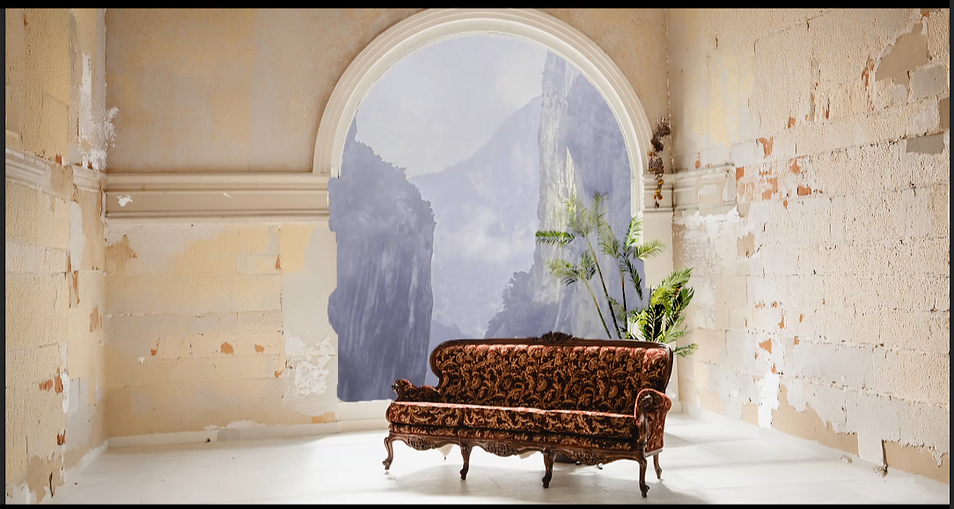
EVIDENCE 19.07
DESCRIPTION
The remaining window muntins have been completely removed, leaving an unobstructed arched opening overlooking the mountain valley. The weathered room, sofa, and potted plant remain unchanged.
OBSERVATIONS
-The landscape is now viewed through a completely open arch.
-The architectural style feels older and more timeless.
-The valley appears more inviting and immersive without the suggestion of glass.
-The room and the exterior feel visually connected rather than separated.
-The composition is cleaner and more focused than in previous evidence.
-No new subjects have been introduced, allowing the environment itself to remain the primary point of interest.
INITIAL QUESTIONS
-Has the setting now reached its final architectural form?
-Who, if anyone, will occupy this room?
-What significance does the empty sofa hold?
-Will the mystery come from the room itself, the landscape beyond, or a new arrival?
-Is the archway intended to be a threshold between two worlds?
CLASSIFICATION
Clue
NOTE
This evidence resolves the uncertainty introduced by the windowpane experiment. Removing the remaining muntins reinforces the illusion that the room opens directly onto the valley, creating a more dreamlike, timeless atmosphere. At this point, the environment feels largely established, and the investigation appears ready to introduce its principal subjects.
EVIDENCE 19.08 - clue

EVIDENCE 19.08
DESCRIPTION
A photograph of a woman in a white dress holding a bouquet has been introduced as a potential subject. The image has been placed over the center of the composition, but has not yet been integrated into the environment. The existing room and mountain scene are temporarily obscured.
OBSERVATIONS
-A human figure appears for the first time in the investigation.
-The woman is looking downward rather than toward the viewer.
-She carries a bouquet of small white flowers.
-Dramatic side lighting creates a quiet, contemplative mood.
-The figure remains confined within the rectangular source image and has not yet been extracted or blended into the room.
-The dark background of the source photograph contrasts sharply with the bright interior established in earlier evidence.
INITIAL QUESTIONS
-Is this the person who belongs in the room?
-Why is she holding flowers?
-Will she remain dressed as a bride, or will her appearance change?
-Where in the room will she ultimately stand?
-Is she the focus of the mystery, or simply one piece of a larger story?
CLASSIFICATION
Clue
NOTE
This evidence introduces the investigation’s first character. At this stage, the woman is clearly a source element rather than part of the scene itself. The primary question is no longer who will occupy the room, but how she will be transformed and what role she will play in the unfolding mystery.
EVIDENCE 19.09 - clue

EVIDENCE 19.09
DESCRIPTION
The woman has been extracted from her source photograph and placed inside the room, standing in front of the sofa and within the arched opening. She remains in her original white gown and continues to hold the bouquet.
OBSERVATIONS
-The woman is now integrated into the composition rather than existing as a separate source image.
-She partially obscures both the sofa and the mountain landscape.
-Her downward gaze creates a quiet, introspective mood.
-The lighting on the figure differs slightly from the room, indicating that blending and color correction have not yet been completed.
-The bouquet becomes the figure’s brightest detail.
-Her placement establishes her as the primary focal point of the investigation.
INITIAL QUESTIONS
-Why is she standing instead of sitting on the sofa?
-Is she waiting for someone, or has she just arrived?
-Does the bouquet have symbolic significance?
-Will she remain dressed in white, or is this only a temporary appearance?
-How will her relationship to the room and the landscape develop?
CLASSIFICATION
Clue
NOTE
This evidence introduces the investigation’s central character into the environment for the first time. The composition shifts from exploring place to exploring presence. While the environment is largely established, the woman has not yet been fully integrated through lighting, color, or atmosphere, making this an important transitional step toward the final narrative.
EVIDENCE 19.10 - clue

EVIDENCE 19.10
DESCRIPTION
The woman has been moved from the center of the composition to the left side of the room. The couch stays centered. This establishes a clear spatial relationship between the two subjects and opens the view through the archway.
OBSERVATIONS
-The woman is no longer blocking the mountain landscape.
-The sofa is fully visible and occupies its own visual space.
-The composition now forms three distinct focal areas: the woman, the archway, and the sofa.
-The negative space between the woman and the sofa introduces a feeling of anticipation.
-The woman continues to look downward, seemingly unaware of the furniture or the landscape.
-The room feels larger and more balanced than in the previous evidence.
INITIAL QUESTIONS
-Why is the woman standing apart from the sofa instead of approaching it?
-Is the space between them intentional?
-Is she about to leave, arrive, or simply pause?
-Does the sofa represent comfort, memory, or someone else’s presence?
-Is the distance between the woman and the furniture part of the mystery?
CLASSIFICATION
Clue
NOTE
This is an important compositional refinement. Separating the woman from the sofa gives each subject its own visual weight and keeps the archway unobstructed. More importantly, it creates a subtle narrative tension: the room contains both a person and a place to rest, yet there is no interaction between them. That unanswered relationship becomes one of the investigation’s earliest narrative clues.
EVIDENCE 19.11 - clue

EVIDENCE 19.11
DESCRIPTION
A dark textured ground has been added across the bottom of the composition, replacing the bright white floor. The woman, sofa, and room remain in the same positions.
OBSERVATIONS
-The bright floor is no longer the dominant foreground element.
-The new ground visually anchors both the woman and the sofa.
-The darker foreground increases the contrast with the light walls and archway.
-The room immediately feels older and more atmospheric.
-The dark ground creates a stronger visual path from the woman toward the sofa.
-The composition gains more depth, with distinct foreground, middle ground, and background layers.
INITIAL QUESTIONS
-Is this meant to be stone, earth, ash, or shadow?
-Should the floor become more detailed or remain abstract?
-Does the dark foreground contribute to the mood, or overpower the lighter architecture?
-Why does the room no longer feel pristine?
-Is this floor evidence of abandonment or simply artistic stylization?
CLASSIFICATION
Clue
NOTE
This evidence grounds the entire scene, both visually and emotionally. The bright white floor had drawn unnecessary attention and made the room feel unfinished. Introducing the darker foreground gives the subjects a believable surface to occupy while shifting the atmosphere toward the mysterious, weathered world that defines the investigation. It is a subtle but important environmental refinement.
EVIDENCE 19.12 - clue

EVIDENCE 19.12
DESCRIPTION
The dark-textured ground has been refined into a more believable stone floor with soft blue-gray tones and integrated shadows. The woman, sofa, and surrounding architecture remain unchanged.
OBSERVATIONS
-The floor now appears to be part of the room rather than an applied texture.
-Cooler blue-gray tones complement the mountain landscape beyond the arch.
-Shadows beneath the sofa strengthen the illusion that it is resting naturally on the floor.
-The dark mass in the lower left has been softened and blended into the environment.
-The foreground feels cleaner and more intentional than in the previous evidence.
-The room now has a more convincing sense of depth and physical space.
INITIAL QUESTIONS
-Is the floor finished, or will additional texture and lighting be needed?
-Should the floor remain subtle, or become a more prominent design element?
-How will future subjects interact with the floor lighting?
-Does the cooler foreground better support the room’s atmosphere?
CLASSIFICATION
Clue
NOTE
This evidence refines rather than reinvents the previous step. The floor transitions from an abstract dark base into a believable architectural surface, helping unify the woman, sofa, and room within the same space. While the narrative has not changed, the environmental realism has noticeably improved, creating a stronger foundation for the investigation as additional subjects are introduced.
EVIDENCE 19.13 - clue

EVIDENCE 19.13
DESCRIPTION
The mountain landscape beyond the archway has been recolored with cooler green and teal tones. The room, woman, sofa, and floor remain otherwise unchanged.
OBSERVATIONS
-The valley now appears greener and more natural.
-The cool tones create a stronger harmony between the landscape and the potted plant.
-Atmospheric haze becomes more noticeable, increasing the sense of distance.
-The cliffs feel softer and less photographic.
-The room’s warm stone colors now contrast more effectively with the cool landscape beyond.
-The overall mood shifts from neutral to tranquil and quietly mysterious.
INITIAL QUESTIONS
-Is this the final color palette for the landscape?
-Should the valley remain softly atmospheric or become more dramatic?
-Does the cooler palette better support the emotional tone of the investigation?
-Will additional elements eventually occupy the valley, or should it remain undisturbed?
CLASSIFICATION
Clue
NOTE
This evidence is primarily a color refinement rather than a compositional change. By shifting the landscape toward muted greens and teals, the outside world feels more cohesive with the room while preserving its sense of depth and mystery. The adjustment also begins moving the entire piece toward the earthy palette that defines the finished investigation.
EVIDENCE 19.14 - clue

EVIDENCE 19.14
DESCRIPTION
The foreground shadows and floor have been further refined, with deeper blue-green tones appearing beneath and around the sofa. Minor blending adjustments have also been made between the room and the landscape.
OBSERVATIONS
-The floor now shows greater tonal variation, rather than appearing uniformly gray.
-Blue-green reflections beneath the sofa visually tie the foreground to the landscape beyond the arch.
-The sofa feels more firmly grounded within the room.
-The transition between the archway and the valley appears smoother.
-The overall atmosphere is becoming richer and more cohesive without introducing new subjects.
-The changes are subtle but increase the realism and depth of the environment.
INITIAL QUESTIONS
-Are the blue-green tones suggesting reflected light from the valley?
-Does the floor need any additional texture, or has it reached the right level of detail?
-Should the environment remain understated so that future focal elements stand out?
-Is the room now visually complete, leaving only narrative elements to be added?
CLASSIFICATION
Clue
NOTE
This evidence is another environmental refinement. Nothing new is introduced, but the existing elements begin to feel like they belong to the same world. The cooler shadows beneath the sofa help unify the interior with the landscape outside, strengthening the illusion that the valley’s light is influencing the room itself. The investigation continues to build atmosphere before introducing the next major clue.
EVIDENCE 19.15 - clue

EVIDENCE 19.15
DESCRIPTION
The woman has been temporarily replaced with a parchment-textured silhouette that preserves her overall shape while removing all facial features, clothing details, and lighting. The room and the surrounding environment remain unchanged.
OBSERVATIONS
-The figure is reduced to a simple silhouette.
-The parchment texture echoes the aged walls and architectural surfaces.
-Individual identity is temporarily removed, leaving only posture and gesture.
-The bouquet remains recognizable through its outline.
-The silhouette reads almost like a paper cutout awaiting further transformation.
-The figure feels more symbolic than human.
INITIAL QUESTIONS
-Should the woman retain realistic details, or become more painterly?
-Does simplifying the figure strengthen or weaken the composition?
-Is the investigation moving toward a collage aesthetic rather than photorealism?
-How much of the original photograph should remain visible in the final artwork?
-Can the figure become part of the environment instead of appearing pasted into it?
CLASSIFICATION
Clue
NOTE
This evidence marks a significant stylistic experiment. Rather than changing the composition, it explores how the central figure should exist within the investigation’s world. By stripping away photographic detail, the test asks whether the woman should be read as a realistic person or as a constructed element within the surreal collage. Although the exact treatment does not survive to the final piece, it points the investigation toward a more unified, painterly aesthetic.
EVIDENCE 19.16 - clue

EVIDENCE 19.16
DESCRIPTION
The woman has been restored from the silhouette experiment and blended with the parchment treatment. Her photographic details remain visible, but her dress and figure now have a softer, more textured appearance that better matches the environment.
OBSERVATIONS
-The woman’s facial features and bouquet have returned.
-The dress appears less photographic and more painterly than before.
-The parchment texture subtly integrates her into the aged surroundings.
-Her lighting feels warmer and more consistent with the room.
-The figure no longer reads as a pasted photograph but as part of the artwork itself.
-The room, landscape, and sofa remain compositionally unchanged, thereby emphasizing the figure’s stylistic refinement.
INITIAL QUESTIONS
-Has the woman now reached her final visual style?
-Should the parchment effect be strengthened or softened?
-Will additional color adjustments further integrate her into the environment?
-Is this the balance between realism and collage that the investigation has been searching for?
CLASSIFICATION
Clue
NOTE
This evidence resolves the stylistic experiment introduced in Evidence 19.15. Rather than abandoning realism or adopting an entirely photographic approach, the investigation finds a middle ground. The woman now belongs to the same visual language as the weathered architecture, making her feel discovered within the room instead of placed there. This is an important stylistic step toward the finished artwork.
EVIDENCE 19.17 - clue

EVIDENCE 19.17
DESCRIPTION
The woman has been replaced with a gold-leaf silhouette, preserving her pose and bouquet. All facial features, clothing details, and lighting have been removed, leaving only a richly textured metallic figure against the muted room.
OBSERVATIONS
-The gold silhouette immediately becomes the brightest focal point in the composition.
-The metallic texture contrasts sharply with the weathered plaster walls and cool landscape.
-The figure reads more like an icon, statue, or symbolic presence than a person.
-The bouquet remains identifiable through its silhouette.
-The warm gold introduces a new color that is absent elsewhere in the scene.
-The experiment emphasizes shape and symbolism over individual identity.
INITIAL QUESTIONS
-Would a symbolic figure be more compelling than a realistic woman?
-Does the gold add mystery, or does it distract from the atmosphere?
-Is the figure becoming an artifact instead of a character?
-Does this visual language belong in the world of the Archive of Impossible Cases?
-Should the warmth of the gold be echoed elsewhere in the composition?
CLASSIFICATION
Clue
NOTE
This evidence explores a different artistic direction than the parchment silhouette. Instead of blending the woman into the environment, the gold leaf treatment elevates her into something almost sacred or relic-like. Although this exact appearance does not survive in the finished artwork, it tests an important question: should the central figure be read as a person, or as a symbol? The investigation ultimately favors humanity over iconography, but this experiment helps define that choice.
EVIDENCE 19.18 - clue

EVIDENCE 19.18
DESCRIPTION
The woman’s dress has been recolored from white to deep blue, while her pose, bouquet, and placement remain unchanged. The rest of the composition is largely unchanged.
OBSERVATIONS
-The blue dress immediately harmonizes with the cool tones of the mountain valley.
-The figure becomes more integrated into the overall color palette.
-The deep blue creates a stronger contrast with the warm stone walls.
-The woman feels more mysterious and less overtly bridal.
-The bouquet now stands out more clearly against the darker clothing.
-The figure retains her contemplative posture, but the mood shifts from ceremonial to introspective.
INITIAL QUESTIONS
-Is blue the final color for the dress?
-Does removing the bridal white change the story being told?
-Is she simply a woman carrying flowers rather than a bride?
-Does the blue make her feel more like she belongs to this world?
-Will additional color adjustments be needed to balance the composition?
CLASSIFICATION
Clue
NOTE
This is one of the investigation’s most significant narrative shifts. Changing the dress from white to deep blue removes many of the assumptions viewers naturally make about a bride and opens the story to broader interpretation. Instead of asking “Who is she marrying?” the viewer is free to ask “Who is she?” and “Why is she here?” The new color also begins establishing the visual identity that carries into the finished artwork.
EVIDENCE 19.19 - clue

EVIDENCE 19.19
DESCRIPTION
The blue dress has been refined with warmer highlights and more natural lighting. The woman’s skin tones and hair have also been adjusted, improving her integration with the room’s warm illumination. The environment remains compositionally unchanged.
OBSERVATIONS
-The woman’s face and hair are more clearly defined than in the previous evidence.
-Warm highlights on her shoulders and upper body better match the light entering the room.
-The blue dress retains its deep color while gaining greater tonal variation.
-The figure appears more dimensional and less uniformly tinted.
-The bouquet remains one of the figure’s brightest details.
-The overall color balance between the woman, the room, and the landscape feels more cohesive.
INITIAL QUESTIONS
-Has the woman’s lighting reached a believable balance with the environment?
-Should the dress become even more textured or painterly?
-Does the warmer skin tone help the figure feel more alive within the scene?
-Is the figure now visually established, allowing attention to shift to other narrative elements?
CLASSIFICATION
Clue
NOTE
This evidence is a refinement of the previous color transformation rather than a new compositional development. The blue dress remains, but the figure now feels illuminated by the same world as the room itself. The adjustments reduce the appearance of a photographic overlay and move the investigation closer to a unified painterly atmosphere. At this stage, the central character feels largely established, making the composition ready for the introduction of the remaining clues that will define the mystery.
EVIDENCE 19.20 - dead end

EVIDENCE 19.20
DESCRIPTION
The mountain valley has been temporarily replaced with an oversized view of pink flowers photographed from below against a bright blue sky. The woman, sofa, and room remain unchanged.
OBSERVATIONS
-The landscape beyond the arch shifts from distant to extremely close.
-The oversized flowers dominate the opening and become the immediate focal point.
-The bright blue sky dramatically increases the overall brightness of the composition.
-The scale of the flowers introduces a whimsical tone that contrasts with the quieter atmosphere established earlier.
-The woman and sofa now compete with the flowers for attention.
-The environmental depth created by the mountain valley is largely lost.
INITIAL QUESTIONS
-Should the mystery take place in a garden rather than a mountain landscape?
-Does changing the outside world strengthen the story or distract from it?
-Are the oversized flowers intriguing enough to justify replacing the valley?
-Is the outside meant to feel expansive or intimate?
CLASSIFICATION
Dead end
NOTE
This experiment explored replacing the distant valley with an oversized floral landscape. While the exaggerated scale fit the investigation’s surreal nature, it fundamentally altered the emotional tone of the piece. The flowers overwhelmed the room, shifted attention away from the woman, and replaced quiet mystery with visual spectacle. The investigation ultimately returned to the mountain landscape, confirming that the original setting better supported the atmosphere and narrative.
EVIDENCE 19.21 - dead end

EVIDENCE 19.21
DESCRIPTION
A translucent overlay of oversized flowers has been blended across the entire composition while the mountain landscape remains visible beneath. The floral imagery extends across the woman, the room, the sofa, and the walls, rather than existing only beyond the archway.
OBSERVATIONS
-The flowers now function as an overlay instead of a destination beyond the arch.
-Multiple focal points compete for attention.
-The woman’s silhouette becomes partially obscured by the floral textures.
-The architecture loses clarity as the overlay spreads across the room.
-The mountain landscape remains visible but is visually diluted.
-The dreamy quality increases, but the scene becomes harder to read at a glance.
INITIAL QUESTIONS
-Should surreal elements occupy the room itself rather than the world beyond?
-Does layering imagery increase the mystery or simply reduce clarity?
-Is the investigation about discovering hidden images or about constructing a believable impossible place?
-Does the overlay support the narrative, or distract from it?
CLASSIFICATION
Dead end
NOTE
This experiment preserved the mountain landscape while introducing the flowers as a translucent layer over the entire composition. Although the effect created an ethereal, dreamlike atmosphere, it weakened the visual hierarchy established by earlier evidence. The room, woman, and landscape no longer had clearly defined roles, making the mystery less focused. Returning to a cleaner composition ultimately allowed each clue to carry more narrative weight and preserved the quiet, investigative tone of the final piece.
EVIDENCE 19.22 - clue

EVIDENCE 19.22
DESCRIPTION
The mountain landscape has been enlarged and repositioned within the archway. More of the valley is visible, and the opening is filled more completely, while the woman, sofa, and room remain unchanged.
OBSERVATIONS
-The landscape now occupies the archway more naturally.
-The valley feels broader than in previous evidence.
-The enlarged view reduces the impression that the background is a separate inserted photograph.
-The left cliff now creates a stronger visual frame for the opening.
-The atmosphere beyond the arch feels more immersive and continuous.
-The composition becomes more balanced, with the environment regaining importance alongside the woman.
INITIAL QUESTIONS
-Has the valley now reached the correct scale?
-Does the larger landscape better support the feeling that the room opens into another world?
-Should the landscape extend even farther beyond the visible opening?
-Is the composition now ready for the introduction of additional narrative elements?
CLASSIFICATION
Clue
NOTE
This evidence strengthens one of the investigation’s central ideas: the archway is not simply displaying a landscape; it appears to open onto one. Enlarging the valley removes the feeling of looking at a picture and instead suggests a genuine continuation of space beyond the room. Although the change is subtle, it significantly improves the illusion that the interior and exterior belong to the same impossible world.

EVIDENCE 19.23 - breakthrough

EVIDENCE 19.23
DESCRIPTION
A large engraved bee has been introduced on the right wall of the room. Unlike previous additions, it is integrated into the architecture rather than the landscape, establishing a new relationship between the room and its inhabitants.
OBSERVATIONS
-A giant bee appears for the first time.
-The bee is dramatically oversized compared to the woman, sofa, and room.
-It’s engraved, vintage illustration style complements the weathered architecture.
-Positioned on the right wall, it balances the woman’s placement on the left.
-The bee’s wings extend into the open space, increasing the feeling that it occupies the room rather than simply decorating it.
-The composition immediately gains a strong left-to-right visual dialogue between the woman and the bee.
-The room no longer feels merely abandoned. It now contains something impossible.
INITIAL QUESTIONS
-Why is the bee enormous?
-Is the bee alive, symbolic, or part of the architecture?
-Does the woman know it is there?
-Is the bee guarding the room, observing it, or simply existing within it?
-Why a bee instead of another insect or animal?
-Is this the mystery the investigation has been searching for?
CLASSIFICATION
Breakthrough
NOTE
This evidence fundamentally changes the direction of the investigation. Up to this point, the work focused on establishing a setting and introducing a solitary figure. The appearance of the oversized bee transforms the scene from an atmospheric interior into an impossible case. It introduces the central question that drives the finished artwork and establishes the visual tension that defines the composition. From this point forward, subsequent changes refine the mystery rather than search for one.
EVIDENCE 19.24 - clue

EVIDENCE 19.24
DESCRIPTION
The giant bee has been moved farther to the right, causing part of its body to extend beyond the composition’s edge. The engraved background texture behind the bee has also been removed, allowing it to appear directly against the weathered wall.
OBSERVATIONS
OBSERVATIONS
-The bee now appears less like a printed illustration and more like an object occupying the room.
-Cropping the bee at the edge of the frame makes it feel larger than the visible canvas.
-The removal of the rectangular background integrates the bee more naturally into the architecture.
-The right wall regains its aged texture, which visually unifies the insect with the room.
-The bee no longer competes as strongly with the archway, giving the composition a cleaner visual balance.
-The sense that the bee has entered the room is stronger than in the previous evidence.
INITIAL QUESTIONS
-Should the bee remain partially outside the frame?
-Is the bee physically present, or is it still intended to read as an illustration?
-Does cropping the insect make it feel more imposing?
-Is this the final placement, or should it move closer to the woman?
-Will additional insects appear elsewhere in the composition?
CLASSIFICATION
Clue
NOTE
This evidence refines the breakthrough introduced in Evidence 19.23. Rather than introducing a new idea, it improves the illusion that the bee belongs in the room by removing the visible source rectangle and allowing part of the insect to extend beyond the composition. The result is more subtle, more believable, and considerably more unsettling. The mystery is no longer simply “There’s a giant bee.” It becomes “The bee is so large that the frame can’t contain it.”
EVIDENCE 19.25 - clue

EVIDENCE 19.25
DESCRIPTION
The giant bee has been recolored from black to deep blue, matching the cooler palette established by the woman’s dress and the mountain valley. Its position remains unchanged.
OBSERVATIONS
-The bee now visually harmonizes with the rest of the composition.
-The deep blue softens the stark contrast of the original black engraving.
-The insect still commands attention, but no longer overwhelms the room.
-The shared blue tones create a subtle visual relationship between the bee and the woman.
-The bee continues to contrast against the warm stone wall while feeling more integrated into the artwork’s overall color palette.
-The composition feels more unified than in the previous evidence.
INITIAL QUESTIONS
-Should the bee remain blue, or return to black for greater contrast?
-Does the shared color palette imply a connection between the woman and the bee?
-Is the bee becoming too visually harmonious, reducing its unsettling presence?
-Will additional bees share this coloration?
CLASSIFICATION
Clue
NOTE
This evidence refines the visual language rather than the narrative. By introducing the same cool blue family found in the woman’s dress and the distant landscape, the bee feels less like a foreign object and more like a native inhabitant of this impossible world. The adjustment subtly shifts the viewer’s perception from “an insect has invaded the room” to “this room belongs to a world where creatures like this naturally exist.” I think that’s an important evolution in the investigation.
EVIDENCE 19.26 - clue

EVIDENCE 19.26
DESCRIPTION
The architectural room has been temporarily removed, leaving the woman, sofa, and giant bee directly within the mountain landscape. The archway, walls, and interior setting are absent.
OBSERVATIONS
-The room has disappeared entirely.
-The woman, sofa, and bee now exist outdoors without any architectural context.
-The mountain valley becomes the dominant visual element.
-The sofa immediately feels less unusual because there is no longer an interior to contrast with it.
-The relationship between the woman and the bee remains, but the surrounding mystery is diminished.
-The scene shifts from “an impossible room” to “a surreal landscape.”
INITIAL QUESTIONS
-Is the room essential to the investigation?
-Does the mystery become stronger when ordinary objects exist inside architecture rather than outdoors?
-Why does the sofa feel more believable in the landscape than expected?
-Is the archway itself one of the principal clues?
-Does removing the room simplify the story too much?
CLASSIFICATION
Clue
NOTE
This experiment demonstrates the importance of the setting. Although the woman, sofa, and bee still create an intriguing composition, removing the room also removes much of the tension. The weathered architecture provides the ordinary world against which the impossible elements are measured. The investigation confirms that the room is not merely a backdrop. It is one of the central characters in the case.
EVIDENCE 19.27 - clue

EVIDENCE 19.27
DESCRIPTION
Soft botanical textures and atmospheric overlays have been introduced throughout the room. Faint foliage appears along the lower edges of the composition, while translucent vertical textures wash across the walls and archway. The woman, sofa, bee, and landscape remain in place.
OBSERVATIONS
-The room feels more overgrown and connected to the natural world.
-The translucent overlays soften the hard edges of the architecture.
-Foliage along the bottom corners creates a gradual transition between the floor and the walls.
-The mountain valley appears more integrated with the room rather than existing as a separate backdrop.
-The bee remains a strong focal point despite the added textures.
-The atmosphere becomes richer and more painterly without changing the underlying composition.
INITIAL QUESTIONS
-Should nature appear to be reclaiming the room?
-Do the overlays enhance the atmosphere or make the composition too busy?
-How much environmental texture is enough before it begins distracting from the central mystery?
-Should the room feel abandoned, enchanted, or simply aged?
CLASSIFICATION
Clue
NOTE
This evidence strengthens the atmosphere rather than the narrative. The added textures blur the distinction between interior and exterior, suggesting that the room has existed in this impossible landscape long enough for nature to encroach upon it quietly. Unlike the floral overlays tested earlier, these additions support the mystery without competing for attention. They enrich the world rather than replace it, making the environment feel older, quieter, and more lived in.
EVIDENCE 19.28 - clue

EVIDENCE 19.28
DESCRIPTION
The overall lighting and color grading have been significantly darkened. Richer shadows now fill the room, increasing contrast while preserving the composition established in the previous evidence.
OBSERVATIONS
-The room feels dramatically moodier than before.
-The woman’s illuminated face and shoulders become stronger focal points against the darker surroundings.
-The blue dress gains greater depth and richness.
-The sofa appears more substantial due to the increased shadow contrast.
-The giant bee becomes more ominous as it emerges from the darker right wall.
-The mountain valley recedes slightly, becoming a quieter backdrop instead of competing for attention.
-The atmosphere shifts from weathered and airy to mysterious and cinematic.
INITIAL QUESTIONS
-Has the investigation found its final lighting direction?
-Does the darker atmosphere better support the mystery?
-Should the valley remain subdued, or regain some brightness?
-Is the room now mysterious enough without obscuring important details?
-How will future additions interact with these deeper shadows?
CLASSIFICATION
Clue
NOTE
This evidence represents an important refinement of atmospheric models. Rather than introducing new objects, it changes how the existing world is experienced. The deeper shadows increase the emotional weight of the scene and strengthen the visual hierarchy, naturally guiding the eye from the woman to the archway and finally to the giant bee. The investigation now feels less like an unusual room and more like a place where something impossible has quietly existed for a very long time.
EVIDENCE 19.29 - clue

EVIDENCE 19.29
DESCRIPTION
The room has undergone substantial atmospheric refinement. The walls have been darkened and enriched with warmer earth tones, the valley has gained contrast, and the vegetation around the room has become more pronounced. No new subjects have been introduced.
OBSERVATIONS
-The walls now appear older, richer, and more weathered.
-Warm browns and deep shadows replace the flatter beige tones from earlier evidence.
-The mountain valley has a stronger contrast, making the cliffs more dramatic.
-Vegetation around the floor and lower walls feels more integrated into the room.
-The giant bee remains prominent but blends more naturally into the aged wall.
-The woman’s illuminated face becomes one of the brightest points in the composition.
-The overall atmosphere feels denser and more immersive.
-The room now suggests long abandonment rather than simple age.
INITIAL QUESTIONS
-Has the environment reached its final mood?
-Is the room being reclaimed by nature?
-Should the walls become even darker, or would that overwhelm the scene?
-Does the increased contrast strengthen the mystery without hiding important details?
-Are the remaining changes likely to focus on storytelling rather than environment?
CLASSIFICATION
Clue
NOTE
This evidence represents a major refinement in atmospheric modeling. Earlier versions established the room’s architecture, but this stage gives it history. The richer wall textures, darker shadows, and increased environmental contrast make the room feel inhabited by time itself. Rather than appearing as a constructed collage, the scene begins to read as a believable, impossible place. The investigation is no longer building the world. It is deepening it.
EVIDENCE 19.30 - clue

EVIDENCE 19.30
DESCRIPTION
A small bee has been introduced within the mountain landscape, hovering near the upper left portion of the archway. The giant bee on the wall remains unchanged, creating the first appearance of multiple bees within the same scene.
OBSERVATIONS
-A second bee appears for the first time.
-The new bee is dramatically smaller than the giant bee.
-It is positioned outside the room, within the distant landscape.
-The scale difference immediately raises questions about the relationship between the two insects.
-The bee is subtle enough that it may not be noticed on first viewing.
-The giant bee remains the dominant focal point, while the smaller bee rewards closer inspection.
-The composition now contains a recurring visual motif rather than a single impossible object.
INITIAL QUESTIONS
-Why are there two bees of such different sizes?
-Is the small bee an ordinary bee, or is it simply farther away?
-Does the giant bee belong to the same species?
-Are there more bees hidden elsewhere in the landscape?
-Is the bee outside connected to the one inside the room?
CLASSIFICATION
Clue
NOTE
This evidence quietly expands the world of the investigation. Before this point, the giant bee could be interpreted as a singular impossibility. The introduction of a second, distant bee suggests a broader reality beyond the room. It transforms the question from “Why is there a giant bee?” to “What kind of world contains both ordinary and extraordinary bees?” Because the addition is intentionally understated, it rewards attentive viewers and encourages repeated examination of the scene. In hindsight, it foreshadows the third bee that ultimately appears in the finished artwork, reinforcing the recurring motif without drawing immediate attention to it.
EVIDENCE 19.31 - clue

EVIDENCE 19.31
DESCRIPTION
The small bee within the archway has been softened and blurred, making it appear more distant and in motion. The rest of the composition remains unchanged.
OBSERVATIONS
-The bee is no longer sharply defined.
-Motion blur makes it appear to be flying rather than hovering.
-The softer focus increases the illusion of atmospheric depth.
-The bee is less likely to be noticed immediately, rewarding careful observation.
-The contrast between the blurred distant bee and the sharply detailed giant bee becomes more pronounced.
-The composition now suggests movement instead of a static arrangement of insects.
INITIAL QUESTIONS
-Is the distant bee flying toward the room or away from it?
-Does the blur make the bee feel more believable?
-Should all of the bees be equally noticeable, or should some remain hidden discoveries?
-Is the distant bee intentionally directing the viewer’s eye toward the giant bee?
CLASSIFICATION
Clue
NOTE
This refinement strengthens the illusion that the distant bee occupies the landscape rather than simply being placed upon it. By softening its edges, the investigation introduces depth through both focus and scale. The viewer is encouraged to discover the bee gradually, reinforcing one of the Archive of Impossible Cases’ central ideas: the most interesting evidence is not always the most obvious.
EVIDENCE 19.32 - clue

EVIDENCE 19.32
DESCRIPTION
The distant bee has been reduced in size and repositioned higher within the valley, making it appear farther away and more naturally integrated into the landscape. The room, woman, sofa, and giant bee remain otherwise unchanged.
OBSERVATIONS
-The bee now reads as a distant flying insect rather than a nearby object.
-Its reduced size reinforces the immense scale of the mountain valley.
-The subtle placement makes it easy to overlook during an initial viewing.
-The giant bee remains the dominant insect, while the distant bee quietly supports the world-building.
-The increased separation between the two bees strengthens the illusion that they occupy different depths within the scene.
-The composition feels more believable because the distant bee now follows the perspective established by the landscape.
INITIAL QUESTIONS
-Is the distant bee simply farther away, or is it actually a normal-sized bee?
-Are there additional bees hidden elsewhere in the environment?
-Does the distant bee suggest that the giant bee is not unique?
-How many clues should remain hidden for attentive viewers to discover?
CLASSIFICATION
Clue
NOTE
This refinement i
mproves the environmental storytelling through scale and perspective. By making the bee smaller and placing it deeper within the valley, the investigation shifts attention away from the insect itself and toward what it implies. The tiny bee quietly expands the world beyond the room, suggesting that the impossible extends far beyond the visible walls. It rewards careful observation without interrupting the composition’s primary narrative.
EVIDENCE 19.33 - clue

EVIDENCE 19.33
DESCRIPTION
A realistic honeybee has been introduced into the foreground, hovering in front of the sofa. Unlike the engraved bee on the wall and the distant bee in the valley, this bee appears photographic and occupies the same physical space as the furniture.
OBSERVATIONS
-A third bee appears for the first time.
-This bee is much closer to the viewer than the other two.
-The photographic style contrasts with the engraved illustration of the giant bee.
-Motion blur suggests the bee is actively flying through the room.
-The bee overlaps the sofa, reinforcing its presence within the interior space.
-Three distinct scales of bees are now present: distant, human-scale, and gigantic.
-The composition gains greater depth because each bee occupies a different visual plane.
INITIAL QUESTIONS
-Why are there three bees of different apparent sizes?
-Is the foreground bee an ordinary bee viewed up close, or another unusually large bee?
-Are the bees connected, or simply sharing the same impossible space?
-Does the photographic bee fit stylistically with the rest of the artwork?
-Is this the missing element that explains the giant bee, or does it deepen the mystery?
CLASSIFICATION
Clue
NOTE
This evidence expands the investigation by introducing a third bee at a new depth within the composition. Rather than simply adding another subject, it creates a progression of scale and distance: one bee far away, one bee nearby, and one impossibly large. The result transforms the bees from a single surreal element into a recurring motif that quietly shapes the logic of this impossible world. Even though this particular foreground bee is later refined, the idea of multiple bees occupying different spaces becomes an essential part of the final investigation.
EVIDENCE 19.34 - clue

EVIDENCE 19.34
DESCRIPTION
The realistic honeybee has been moved from the foreground to the upper-left corner of the room. It now hovers above the woman, creating three distinct bee locations within the composition: one inside the room, one outside in the valley, and one impossibly large on the wall.
OBSERVATIONS
-The realistic bee no longer overlaps the sofa.
-Its new placement creates a visual triangle with the woman and the giant bee.
-The bee feels lighter and less intrusive than when it occupied the foreground.
-The woman appears unaware of the bee hovering above her.
-The three bees now occupy separate regions of the composition instead of competing within the same space.
-The upper-left bee naturally balances the giant bee on the opposite side of the image.
-The room feels more alive, as if ordinary wildlife exists alongside the impossible.
INITIAL QUESTIONS
-Are the bees simply members of the same world viewed from different perspectives?
-Does the woman notice any of the bees?
-Is the investigation becoming about the bees themselves rather than the room?
CLASSIFICATION
Clue
NOTE
This repositioning solves an important compositional problem. The foreground bee had competed with the sofa and interrupted the visual flow. By moving it to the upper left, the investigation preserves the idea of three bees while allowing each to occupy its own narrative role. The result is a stronger visual rhythm: a nearby bee inside the room, a distant bee outside the archway, and a giant bee dominating the right wall. Together, they create a layered world where the impossible feels quietly established rather than suddenly introduced.
EVIDENCE 19.35 - clue

EVIDENCE 19.35
DESCRIPTION
A warm parchment-colored atmospheric wash has been applied across the entire composition, muting contrast and softening nearly every element in the scene. The woman, the room, the landscape, the sofa, and all three bees remain in place beneath the overlay.
OBSERVATIONS
-The entire composition becomes lighter and more monochromatic.
-Fine details in the room, landscape, and bees are significantly subdued.
-The atmosphere feels older, dreamier, and more archival.
-The blue dress loses much of its visual impact beneath the warm overlay.
-The giant bee becomes less imposing as its contrast is reduced.
-The image resembles an aged document or faded photograph more than a window into another world.
-The mystery feels more distant because many visual clues are partially obscured.
INITIAL QUESTIONS
-Should the investigation resemble an old archival document?
-Is the parchment effect enhancing the mood or hiding too much evidence?
-How much atmosphere can be added before important details are lost?
-Should the viewer discover the mystery through subtlety or clarity?
CLASSIFICATION
Clue
NOTE
This evidence explores the balance between atmosphere and legibility. The archival wash successfully evokes the feeling of an old case file or a forgotten photograph, reinforcing the Archive of Impossible Cases’ identity. At the same time, it demonstrates that too much atmospheric texture can suppress the very clues the viewer is meant to discover. The investigation ultimately retains the aged character while restoring enough contrast for the woman, the bees, and the room to remain clearly readable.
EVIDENCE 19.36 - clue

EVIDENCE 19.36
DESCRIPTION
The heavy archival wash has been reduced, restoring contrast and color throughout the composition while preserving the warm, aged atmosphere. The woman, the room, the landscape, the sofa, and the three bees remain in their established positions.
OBSERVATIONS
-The blue dress regains its richness and becomes a stronger focal point.
-The mountain valley appears brighter and more inviting.
-The giant bee once again stands out clearly against the weathered wall.
-The realistic bee in the upper left is easier to distinguish from the background.
-The room retains its aged character without obscuring important details.
-The overall color palette feels warmer and more cohesive.
-The composition is easier to read while still maintaining its dreamlike quality.
INITIAL QUESTIONS
-Has the atmosphere reached the right balance between age and clarity?
-Are the remaining changes likely to involve fine details rather than major composition?
-Does the restored contrast make the three bees easier to discover over time?
-Is the investigation now approaching its final visual language?
CLASSIFICATION
Clue
NOTE
This evidence refines the atmospheric experiment from Evidence 19.35. Rather than abandoning the archival aesthetic, the investigation dials it back until the clues become readable again. The result preserves the feeling of an old case file while allowing the woman, the three bees, and the impossible room to remain the primary storytellers. It marks the point at which the atmosphere begins serving the mystery rather than competing with it.
EVIDENCE 19.37 - clue

EVIDENCE 19.37
DESCRIPTION
The composition has undergone another round of tonal refinement. The warm archival overlay has been softened, the walls and arch have gained slightly more contrast, and the overall scene feels cleaner while preserving the aged atmosphere. All principal subjects remain unchanged.
OBSERVATIONS
-The room appears brighter and more balanced than in the previous evidence.
-The woman’s face and bouquet receive slightly greater visual emphasis.
-The giant bee’s engraved details are more legible against the wall.
-The realistic bee in the upper left remains present but blends naturally into the environment.
-The distant bee continues to function as a subtle discovery within the valley.
-The architectural textures regain clarity without losing their weathered appearance.
-The composition feels less filtered and more like a finished painting than an aged photograph.
INITIAL QUESTIONS
-Has the room reached its final balance of light and shadow?
-Do any remaining adjustments need to focus on individual elements rather than the overall atmosphere?
-Is the visual hierarchy now directing the eye in the intended order?
-Are the final refinements now about polishing rather than experimentation?
CLASSIFICATION
Clue
NOTE
This evidence represents the transition from experimentation to refinement. The major compositional decisions have already been made, and the investigation now focuses on achieving visual harmony. The atmosphere remains rich and archival, but the important clues are once again easy to discover. At this stage, the case feels largely solved, with only subtle adjustments remaining before the final artwork emerges.
EVIDENCE 19.38 - clue

EVIDENCE 19.38
DESCRIPTION
The overall composition has been darkened once more, increasing shadow depth throughout the room. The woman, three bees, sofa, and mountain valley remain in their established positions, while the lighting becomes more dramatic and directional.
OBSERVATIONS
-The room now feels quieter and more secluded.
-The woman’s illuminated face and bouquet become the strongest focal point on the left.
-The giant bee emerges from deeper shadow, increasing its sense of presence.
-The valley beyond the arch becomes moodier, with the distant light drawing the eye into the landscape.
-The upper-left bee remains visible but is less immediately noticeable against the darker wall.
-The sofa gains richer contrast and appears more grounded.
-The darker atmosphere increases the feeling that this room has existed undisturbed for a very long time.
INITIAL QUESTIONS
-Has the investigation found its final lighting direction?
-Is the room now too dark, or does the added contrast strengthen the mystery?
-Should the valley remain the brightest element in the composition?
-Are the remaining changes limited to fine tonal adjustments?
CLASSIFICATION
Clue
NOTE
This evidence is a final atmospheric refinement rather than a structural change. The composition itself is now stable, and the investigation focuses on mood. The deeper shadows emphasize the contrast between the known and the unknown: the warm room, the luminous valley, and the impossible bees. At this stage, the artwork feels less like a collage being assembled and more like a forgotten place that has finally been rediscovered.
EVIDENCE 19.39 - clue

EVIDENCE 19.39
DESCRIPTION
The scene has been refined with deeper shadows, richer contrast, and darker environmental tones. The woman, sofa, mountain valley, and all three bees remain in place, while the lighting has been carefully balanced to emphasize the room’s atmosphere and the central mystery.
OBSERVATIONS
-The room now feels more enclosed and intimate.
-The woman’s face and bouquet become the brightest focal point on the left.
-The blue dress gains additional richness against the surrounding shadows.
-The giant bee is more striking without appearing disconnected from the wall.
-The realistic bee in the upper left blends naturally into the room while remaining discoverable.
-The distant bee remains a subtle clue within the valley, encouraging careful observation.
-The valley beyond the arch has greater depth and contrast, drawing the eye into the distance.
-The sofa appears heavier and more grounded within the room.
-The overall visual hierarchy feels settled: woman → valley → giant bee.
INITIAL QUESTIONS
-Has the investigation reached its final stage?
-Do any remaining adjustments need to focus only on polish rather than composition?
-Is the balance between mystery and readability now complete?
-Have all of the important clues been established for the viewer to discover?
CLASSIFICATION
Clue
NOTE
This evidence feels like the investigation is entering its final refinement stage. No major narrative elements are introduced. Instead, attention shifts to the emotional weight of the scene. The deeper shadows, stronger contrast, and controlled lighting unify every clue introduced throughout the case. The room now feels convincingly inhabited by the impossible, while the visual path naturally guides the viewer from the contemplative woman, through the distant valley, to the oversized bee. At this point, the case appears largely solved, with only the final polish remaining before the completed investigation is archived.
EVIDENCE 19.40 - clue

EVIDENCE 19.40
DESCRIPTION
Final tonal adjustments have been applied throughout the composition. Contrast and lighting have been subtly balanced while preserving the established arrangement of the woman, the sofa, the mountain valley, and the three bees.
OBSERVATIONS
-The lighting appears slightly more natural and cohesive than in the previous evidence.
-The woman’s face maintains a warm glow while remaining the primary focal point on the left.
-The giant bee is crisp and clearly separated from the wall, without feeling pasted on.
-The realistic bee in the upper left has become slightly more integrated into the room through tonal matching.
-The distant bee remains barely noticeable, rewarding careful observation.
-The valley feels deeper, with atmospheric haze creating a convincing sense of distance.
-The sofa’s highlights and shadows are more balanced, helping it feel anchored within the room.
-The room’s weathered textures remain visible without competing for attention.
INITIAL QUESTIONS
-Has the investigation reached its final visual balance?
-Are any remaining adjustments purely cosmetic?
-Is the eye naturally traveling through the intended sequence of clues?
-Does every major element now belong convincingly within the same impossible world?
CLASSIFICATION
Clue
NOTE
This evidence represents the final stage of visual calibration. The investigation is no longer changing what exists in the room; it is only changing how the viewer experiences it. Small adjustments to tone, contrast, and lighting unify the disparate source images into a single believable environment. The result is a composition that feels less assembled and more discovered, as though investigators have finally documented a place that had always existed just beyond ordinary perception.
EVIDENCE 19.41 - final art

EVIDENCE 19.41
DESCRIPTION
The investigation is complete. A final painterly treatment has unified the entire composition, giving every element a shared texture and visual language. The room, the mountain valley, the woman, the sofa, and three bees now exist as a single cohesive world.
OBSERVATIONS
-A subtle painterly texture now covers the entire image, eliminating the feeling of separate source photographs.
-The woman remains the emotional anchor of the composition, quietly studying the flowers in her hands.
-The mountain valley appears fully integrated into the arched opening, reading as a true extension of the room.
-The oversized engraved bee on the wall feels architectural, as though it belongs to the building itself.
-The realistic bee in the upper left introduces movement and life within the room.
-The tiny distant bee is barely perceptible, rewarding attentive viewers who linger.
-The sofa sits between the woman and the landscape, acting as the visual threshold between interior and exterior.
-The color palette settles into muted greens, warm stone, deep browns, and cool blue, creating a restrained, timeless atmosphere.
-No element dominates unnaturally. Every object contributes to the same impossible narrative.
INITIAL QUESTIONS
-Why are there three bees?
-Is the woman aware of the bees, or are they only visible to the investigator?
-Is the room opening onto another place, or has nature entered this one?
-What exactly is being investigated: the room, the bees, or the relationship between them?
CLASSIFICATION
Final art
NOTE
Case #0019 concludes not by answering every question, but by establishing a world whose impossible rules feel internally consistent. Throughout the investigation, the room transformed from an ordinary interior into a place where scale, architecture, and nature quietly coexist without explanation. The recurring bee motif became the central clue: one bee nearby, one impossibly large, and one almost hidden in the distance. Together, they suggest that the mystery is larger than any single room.
The final painterly treatment completes the illusion. Individual photographs disappear, replaced by a single coherent reality that feels discovered rather than assembled. The investigation is considered solved, not because every mystery has been explained, but because every piece of evidence now belongs to the same impossible place.