


EVIDENCE 21.01 - clue


EVIDENCE 21.01
DESCRIPTION
Original room photograph.
OBSERVATIONS
-Two upholstered chairs sit near the center of the room with a small table between them.
-Additional bench seating runs along both sides of the room.
-Five tall windows surround the seating area.
INITIAL QUESTIONS
-What kind of room is this?
-Why are there so many places to sit?
-What is happening outside the windows?
CLASSIFICATION
Clue
NOTE
The seating arrangement was already present in the original photograph. It was not yet clear that the room would become a waiting room.

EVIDENCE 21.02 - clue
EVIDENCE 21.02
DESCRIPTION
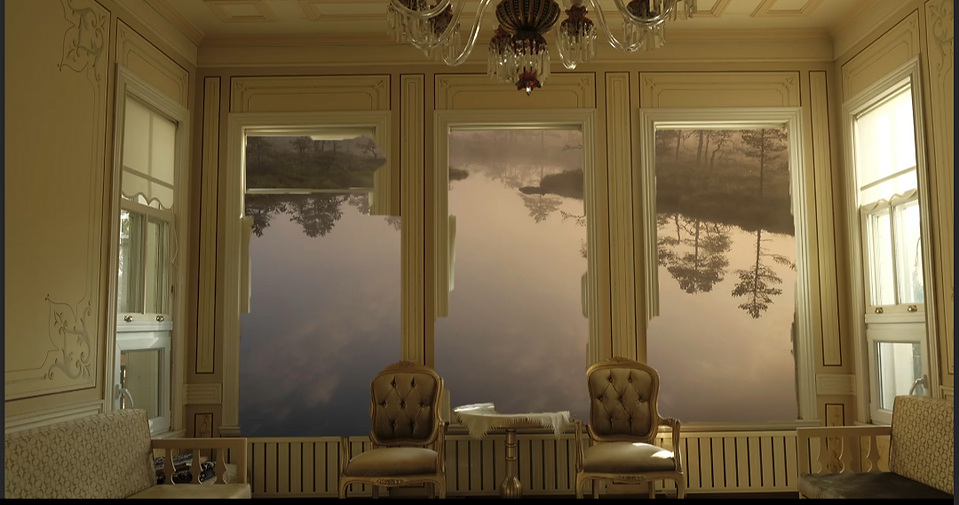
A marsh landscape was added behind the three center windows.
OBSERVATIONS
- The original view outside the center windows has been replaced with water, trees, and their reflections.
- The same landscape extends across all three windows.
- Large areas of open water create space behind the two chairs.
- The two side windows still show the original view.
INITIAL QUESTIONS
- Where is this room now?
- Should the landscape continue through the side windows?
- How can the new landscape be made to feel like it belongs outside the room?
CLASSIFICATION
Clue
NOTE
This was the first major change to the original room and established the landscape that remained through the rest of the investigation.

EVIDENCE 21.03 - clue

EVIDENCE 21.03
DESCRIPTION
Marsh landscape extended into the two side windows.
OBSERVATIONS
- The same landscape now appears through all five windows.
- The original exterior view has been completely replaced.
- The landscape appears to continue around the room rather than existing only behind the three center windows.
- The room now feels surrounded by water and trees.
INITIAL QUESTIONS
- Is the room actually located in this landscape?
- Where does the room end and the landscape begin?
- Does the landscape need to remain consistent across all five windows?
CLASSIFICATION
Clue
NOTE
Extending the landscape into the side windows made the room feel physically located within the marsh rather than simply looking out onto it.

EVIDENCE 21.04 clue

EVIDENCE 21.04
DESCRIPTION
Color adjustment to the room and landscape.
OBSERVATIONS
- The overall color palette has been slightly adjusted.
- The room has a warmer, more muted tone.
- The landscape remains unchanged in composition and placement.
- No new objects or structural elements have been added.
INITIAL QUESTIONS
- Does the color adjustment help the room and landscape feel like they belong together?
- Is the image becoming too warm?
- Does the atmosphere feel right?
CLASSIFICATION
Clue
NOTE
A small color adjustment helped begin bringing the separate elements into the same visual atmosphere.
EVIDENCE 21.05 - clue

EVIDENCE 21.05
DESCRIPTION
Brightness and color adjustments to the room.
OBSERVATIONS
- The room is brighter and noticeably warmer than the previous version.
- Golden tones are stronger across the walls, furniture, and window frames.
- The increased brightness reveals more detail in the chairs and architectural features.
- The landscape remains darker and more muted than the surrounding room.
INITIAL QUESTIONS
- Is the room becoming too warm?
- Does the brighter interior work with the darker landscape?
- Does the stronger contrast improve the atmosphere?
CLASSIFICATION
Clue
NOTE
Further color and brightness adjustments pushed the room toward a much warmer, golden palette while increasing the separation between the interior and the landscape.
EVIDENCE 21.06 - clue

EVIDENCE 21.06
DESCRIPTION
Color shifted from warm gold to cool blue.
OBSERVATIONS
- The room has changed from a warm golden palette to a cool blue-gray palette.
- The landscape retains warmer brown and gold tones.
- The chairs and architectural details now feel colder and more subdued.
- The contrast between the interior and exterior is more pronounced.
INITIAL QUESTIONS
- Does the cooler room create a stronger separation from the landscape?
- Should the interior and exterior feel as though they belong to different environments?
- Is this closer to the atmosphere the room needs?
CLASSIFICATION
Clue
NOTE
The dramatic shift from warm to cool changed the room’s mood and established the cool-interior/warm-exterior contrast that would continue developing.

EVIDENCE 21.07 - breakthrough

EVIDENCE 21.07
DESCRIPTION
The cool interior darkened while warmth returned to the right side and landscape.
OBSERVATIONS
- The left side of the room is significantly darker than the right.
- Cool blue-gray tones remain throughout most of the interior.
- Warm gold light begins entering from the right side of the room.
- The landscape remains warm and luminous against the cooler interior.
- The room now has a clear transition from dark/cool on the left to light/warm on the right.
INITIAL QUESTIONS
- Should the room remain divided between cool and warm light?
- Can this contrast help make the landscape feel separate from the interior?
- What happens if the difference between the two sides is pushed further?
CLASSIFICATION
Breakthrough
NOTE
This established the color and lighting direction that finally felt right: a darker, cooler interior interrupted by the landscape’s warm light.
EVIDENCE 21.08 - clue

EVIDENCE 21.08
DESCRIPTION
Upper sections of the two left center window frames removed.
OBSERVATIONS
- Portions of the original window frames have been removed from the two left center windows.
- The landscape now extends higher into the openings without being divided by the original window structure.
- The right center window still retains its original frame.
- The three center openings are beginning to behave differently from one another.
INITIAL QUESTIONS
- What happens if the windows stop looking like ordinary windows?
- Should all three center openings be altered?
- What should separate the room from the landscape?
CLASSIFICATION
Clue
NOTE
Removing parts of the original window structure began transforming the center windows into something less recognizable and opened the possibility that they might become something other than windows.

EVIDENCE 21.09 - clue

EVIDENCE 21.09
DESCRIPTION
Remaining window structures removed and landscape repositioned.
OBSERVATIONS
- The original window structures have now been removed from all three center openings.
- The landscape has been repositioned so more of the trees and shoreline are visible.
- The three center openings are larger and less recognizable as conventional windows.
- The side windows still retain their original architectural frames.
- The landscape appears continuous across all five openings.
INITIAL QUESTIONS
- What are the three center openings becoming?
- Should they still read as windows?
- How can the center openings be separated from the surrounding architecture without turning them back into ordinary windows?
CLASSIFICATION
Clue
NOTE
With the remaining window structures removed, the three center openings stopped behaving like normal windows. The landscape became more prominent, but the openings still needed something to define them.
EVIDENCE 21.10 - clue
EVIDENCE 21.10
DESCRIPTION
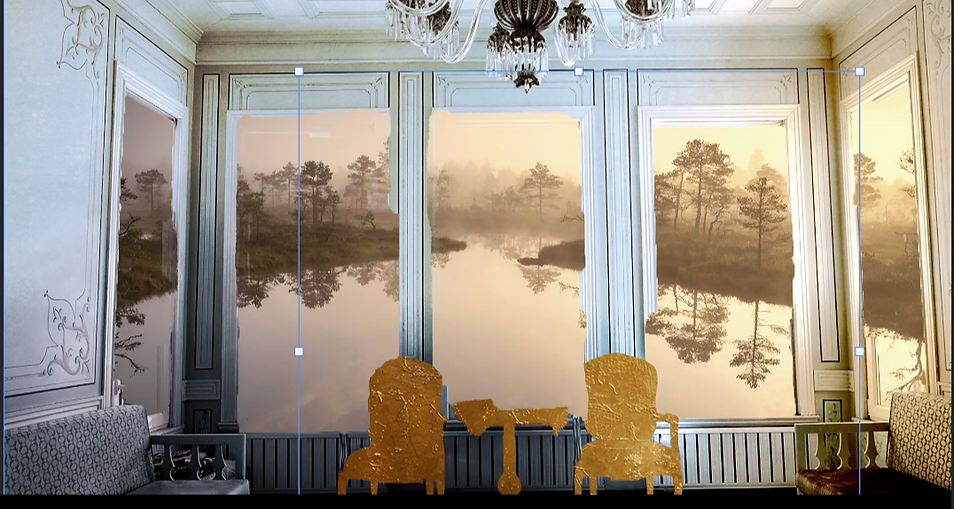
Gold texture applied to the two center chairs and table.
OBSERVATIONS
- The two chairs and small table have been covered in a metallic gold texture.
- Their original upholstery, color, and surface details are almost completely obscured.
- The furniture now stands apart sharply from the cooler room and natural landscape.
- The shapes of the chairs and table remain recognizable despite the new surface treatment.
INITIAL QUESTIONS
- Should the furniture become something less ordinary?
- Does the gold make the chairs and table more important to the scene?
- Is the metallic treatment too visually dominant?
CLASSIFICATION
Clue
NOTE
The gold treatment was an attempt to make the central furniture feel stranger and more significant, but it dramatically changed its relationship to the rest of the room.
EVIDENCE 21.11 - clue

EVIDENCE 21.11
DESCRIPTION
Gold texture blended into the two center chairs and table.
OBSERVATIONS
- The metallic gold texture has been blended with the furniture rather than covering it completely.
- The original upholstery and details of both chairs are visible again.
- Gold tones remain on the chairs and table but are much more subtle.
- The furniture feels more integrated with the room while retaining some of the warmer metallic color.
INITIAL QUESTIONS
- Is the gold subtle enough to belong in the room?
- Does the blended texture add interest without overpowering the furniture?
- Should the metallic treatment stay?
CLASSIFICATION
Clue
NOTE
Blending the gold texture preserved the original character and detail of the furniture while keeping some of the warmth and metallic effect.
EVIDENCE 21.12 - clue

EVIDENCE 21.12
DESCRIPTION
A warm textured overlay was applied across the entire image.
OBSERVATIONS
- A visible surface texture has been added across the room and landscape.
- The overall palette has shifted warmer and more golden.
- The landscape is brighter and more saturated than in the previous version.
- The texture helps visually connect the photographic elements of the room and landscape.
- The cooler blue-gray tones of the room are less prominent.
INITIAL QUESTIONS
- Does the texture help unify the separate elements?
- Has the image become too warm again?
- How much texture should remain visible in the finished piece?
CLASSIFICATION
Clue
NOTE
Adding texture gave the separate photographic elements a shared surface and pushed the image toward a more painterly, unified appearance.
EVIDENCE 20.13 - dead end

EVIDENCE 21.13
DESCRIPTION
Original window structures restored over the landscape.
OBSERVATIONS
- The original window frames and lower window details have been brought back into the three center openings.
- The landscape remains visible through and over portions of the windows.
- The cool blue interior and warm landscape create strong color contrast.
- The windows once again read clearly as conventional windows.
- The added structure makes the center of the image feel busier and more fragmented.
INITIAL QUESTIONS
- Do the original windows make the scene feel too ordinary?
- Is there too much visual information competing with the landscape?
- Were the simpler openings stronger?
CLASSIFICATION
Dead end
NOTE
Restoring the original window structures took the image backward. The openings became ordinary windows again and lost the strange, undefined quality that had started to develop.
EVIDENCE 20.14 - clue

EVIDENCE 21.14
DESCRIPTION
Chromatic distortion effect applied across the image.
OBSERVATIONS
- Red, green, and blue edges appear around the architecture, furniture, and landscape.
- The image has a slightly blurred, doubled appearance.
- The room and landscape feel less visually stable than before.
- The effect makes the scene feel distorted without changing its physical contents.
- The original window structures are still present.
INITIAL QUESTIONS
- Can distortion make the room feel less stable or ordinary?
- Does the effect add to the mystery or distract from it?
- Is there a subtler way to create this sense of instability?
CLASSIFICATION
Clue
NOTE
The distortion introduced the idea that the room itself could feel visually unstable, even though this particular effect would not remain in the final piece.
EVIDENCE 21.15 - clue

EVIDENCE 21.15
DESCRIPTION
Dark blue treatment applied to the three center window frames.
OBSERVATIONS
- The three center window frames have been shifted to a dark blue-gray.
- The cooler frames stand apart from the warmer walls and landscape.
- The three center windows are now visually grouped.
- The blue treatment draws attention to the boundaries between the room and the openings.
- The two side windows remain visually different from the three center windows.
INITIAL QUESTIONS
- Should the three center frames remain visually distinct from the rest of the room?
- Can the blue treatment become something stranger than ordinary painted window frames?
- What happens if the effect around the frames is pushed further?
CLASSIFICATION
Clue
NOTE
The dark blue frames did not remain this way. Still, this experiment introduced the cool blue treatment that eventually developed into the pale, frosted blue effect surrounding the three center openings in the final artwork.
EVIDENCE 21.16 - clue
EVIDENCE 21.16
DESCRIPTION
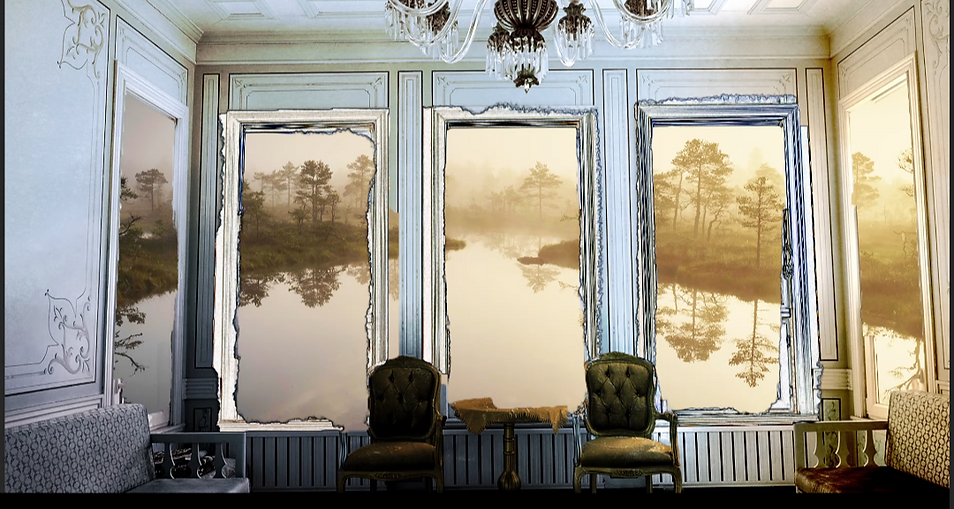
Blue window treatment transformed into irregular frames around the three center openings.
OBSERVATIONS
- The dark blue treatment from the previous version has developed into defined frames around each of the three center openings.
- The frames have uneven, distressed edges rather than clean architectural lines.
- The original window structures are no longer visible inside the three center openings.
- The landscape is fully visible within each frame.
- The three framed openings now look distinctly different from the two side windows.
INITIAL QUESTIONS
- Are these still windows, or have they become something else?
- Why are only the three center openings framed this way?
- How far should the strange blue frame effect be pushed?
CLASSIFICATION
Clue
NOTE
The earlier blue window experiment evolved into these irregular frames. This established the basic form that would later become the pale, frosted blue frames in the finished artwork.
EVIDENCE 21.17 - clue

EVIDENCE 21.17
DESCRIPTION
Frame colors darkened and blended into the room.
OBSERVATIONS
- The three irregular frames have shifted from pale blue-white to darker blue, gray, and brown tones.
- The distressed edges remain visible around all three openings.
- The frames feel more integrated with the surrounding architecture than in the previous version.
- The landscape remains bright and warm inside the darker frames.
- The contrast between the frames and the landscape makes the three openings more prominent.
INITIAL QUESTIONS
- Do the darker frames work better with the room?
- Should the frames look like physical objects or something less solid?
- Can the frames be integrated without losing their strange quality?
CLASSIFICATION
Clue
NOTE
Darkening and blending the frames helped integrate them into the room while preserving the irregular shape established in the previous version.
EVIDENCE 21.18 - clue

EVIDENCE 21.18
DESCRIPTION
Frosted blue texture added around the three center frames.
OBSERVATIONS
- The three frames have shifted from dark, solid edges to a pale blue and violet treatment.
- The new texture extends beyond the frames and partially onto the surrounding walls.
- The edges appear translucent and irregular rather than completely solid.
- The cool blue-violet contrasts strongly with the warm golden landscape.
- The three center openings now feel visually separate from the ordinary side windows.
INITIAL QUESTIONS
- What exactly are these openings now?
- Should the blue effect remain contained to the frames or spread beyond them?
- Does the frosted appearance make the frames feel less physical?
- Why are only these three openings affected?
CLASSIFICATION
Clue
NOTE
The darker frames evolved into the pale, frosted blue effect that would remain in the final artwork. At this point, the three center openings no longer felt like ordinary windows.

EVIDENCE 21.19 - breakthrough

EVIDENCE 21.19
DESCRIPTION
“PLEASE WAIT” letter board introduced.
OBSERVATIONS
- A small letter board reading “PLEASE WAIT” is introduced.
- The phrase gives the room an implied purpose that was not previously explicit.
- The existing chairs, benches, and table suddenly begin to read as waiting-room furniture.
- The instruction introduces the idea that someone is expected to wait, although no people are present.
- Nothing indicates what anyone is waiting for.
INITIAL QUESTIONS
- Is this a waiting room?
- Who is supposed to wait here?
- What are they waiting for?
- What happens when the waiting is over?
CLASSIFICATION
Breakthrough
NOTE
This changed the direction of the case. The furniture had been present from the beginning, but “PLEASE WAIT” gave the seating arrangement a new meaning. The room was no longer simply a strange room surrounded by an impossible landscape. It became a waiting room, introducing the question of what anyone here is waiting for.

EVIDENCE 21.20 - red herring

EVIDENCE 21.20
DESCRIPTION
“PLEASE WAIT” sign isolated and placed into the room.
OBSERVATIONS
- The background has been removed from the “PLEASE WAIT” sign.
- The sign is now physically introduced into the waiting room for the first time.
- Its large size and central placement temporarily make it the dominant element in the image.
- The words “PLEASE WAIT” now appear directly alongside the empty chairs and benches.
- The sign still needs to be integrated into the architecture.
INITIAL QUESTIONS
- Where should the sign be placed?
- How large should it be?
- Can the sign be visible without becoming the focal point?
- Will “PLEASE WAIT” be enough to establish this as a waiting room?
CLASSIFICATION
Clue
NOTE
With the sign removed from its original photograph and brought into the room, the waiting-room idea became part of the artwork itself. The next problem was finding a placement subtle enough that the viewer could discover the instruction rather than having it explain the entire image.
EVIDENCE 21.21 - clue

EVIDENCE 21.21
DESCRIPTION
Letter tiles separated from the original sign.
OBSERVATIONS
- The “PLEASE WAIT” letters have been removed from the black letter board.
- The individual tiles now float directly within the room.
- Removing the board makes the message feel less like a modern sign and more like something belonging to the strange space itself.
- “PLEASE” and “WAIT” remain different sizes, preserving some of the original sign’s visual character.
- The message is still much too large and centrally placed to remain here.
INITIAL QUESTIONS
- Can the letters be incorporated directly into the architecture?
- Where can the message live without dominating the artwork?
- Should the words look deliberately posted or almost accidentally discovered?
- Can “PLEASE WAIT” become part of the room rather than an object placed inside it?
CLASSIFICATION
Clue
NOTE
Removing the black sign was important. I wanted to keep the instruction but not the object it came from. This opened up the possibility of hiding “PLEASE WAIT” somewhere in the architecture, where it could function as a clue rather than an explanation.

EVIDENCE 21.22 - clue

EVIDENCE 21.22
DESCRIPTION
“PLEASE WAIT” resized and repositioned.
OBSERVATIONS
- The separated letter tiles have been reduced in size.
- The words remain centered between the windows while their scale is tested.
- The smaller size begins to shift the message away from being the dominant focal point.
- “PLEASE WAIT” now feels more capable of becoming a detail within the room rather than the subject of the artwork.
- The placement still feels temporary and disconnected from the architecture.
INITIAL QUESTIONS
- How small can the message become and still be readable?
- Where would an actual instruction belong in this room?
- Can it be moved somewhere the viewer discovers only after looking around?
- Could the architecture itself provide a place for the letters?
CLASSIFICATION
Clue
NOTE
The message was right, but the placement wasn’t. I started shrinking it down to see whether “PLEASE WAIT” could become something the viewer notices rather than something the artwork announces.

EVIDENCE 21.23 - breakthrough

EVIDENCE 21.23
DESCRIPTION
“PLEASE WAIT” moved into its final position above the right window.
OBSERVATIONS
- The letter tiles have been moved out of the center of the composition.
- “PLEASE WAIT” now sits high on the wall above the far-right window.
- The letters follow the angle and perspective of the architecture.
- The message is readable, but no longer demands immediate attention.
- The instruction now feels embedded in the room rather than placed over the artwork.
- The empty chairs and benches can establish the waiting-room feeling first, with the sign acting as confirmation.
INITIAL QUESTIONS
- Is this subtle enough to be discovered rather than announced?
- Why does this room tell its occupants to wait?
- Who put the instruction there?
- How long are they expected to wait?
- What happens when their wait is over?
CLASSIFICATION
Breakthrough
NOTE
Found it. Moving “PLEASE WAIT” above the right window solved the placement problem. The sign could stay in the final artwork without breaking the spell. It confirms that this is a waiting room, but only after the viewer notices it.
EVIDENCE 21.24 - clue

EVIDENCE 21.24
DESCRIPTION
“PLEASE WAIT” sign adjusted to better match the room.
OBSERVATIONS
- The sign remains in its established position above the right window.
- The tiles have been softened and blended into the pale architecture.
- The message is less visually prominent than before.
- “PLEASE WAIT” now looks more like something that has always belonged to the room.
- The sign remains legible enough to confirm the waiting-room idea without immediately giving it away.
INITIAL QUESTIONS
- How much should the sign disappear into the room?
- Will viewers notice it only after they have already begun wondering about the chairs?
- Does making the instruction quieter make the room feel stranger?
- What exactly are visitors being asked to wait for?
CLASSIFICATION
Clue
NOTE
The placement was already solved. This was about integration. I wanted the sign to feel less pasted onto the wall and more like an instruction that had been there for a very long time.
EVIDENCE 21.25 - clue

EVIDENCE 21.25
DESCRIPTION
The landscape extends into the room from the left.
OBSERVATIONS
- A large section of the exterior landscape has been extended beyond the left window.
- The trees and their reflection now cross over the architectural boundary of the room.
- The landscape partially covers the wall and overlaps the left side of the composition.
- The distinction between “inside” and “outside” becomes less reliable.
- The intrusion is much darker and heavier than the misty landscape visible through the other openings.
- The waiting room now appears to be physically interacting with whatever exists beyond it.
INITIAL QUESTIONS
- Is the landscape coming into the room?
- Where does the room actually end?
- Should the intrusion remain this solid or become more translucent?
- Is the landscape outside the windows at all?
- What kind of place has boundaries that behave like this?
CLASSIFICATION
Clue
NOTE
I started pulling the landscape past the window instead of keeping it neatly contained behind the architecture. This made the room feel less like a normal interior with an impossible view, and more like the two spaces might be bleeding into each other.
EVIDENCE 21.26 - clue

EVIDENCE 21.26
DESCRIPTION
Intruding landscape reduced and repositioned.
OBSERVATIONS
- The landscape extending into the room has been significantly reduced in size.
- It remains outside the boundary of the left window, overlapping the wall.
- The smaller scale makes the intrusion less overwhelming while preserving the broken inside/outside boundary.
- The landscape now appears to seep into the room rather than engulf it.
- Its placement begins to echo the landscape already visible through the left window.
- The room remains recognizable while something impossible is clearly happening at its edge.
INITIAL QUESTIONS
- How far should the landscape intrude into the room?
- Can the transition between the two spaces become less obvious?
- Should the landscape look solid, translucent, or somewhere between the two?
- Is the outside entering the room, or is the room disappearing into the outside?
- Where is the actual boundary between these spaces?
CLASSIFICATION
Clue
NOTE
The previous version was too much. Scaling the landscape back kept the idea I wanted without letting it take over the composition. The boundary is still broken, but now it feels more uncertain, which is much more interesting.

EVIDENCE 21.27 - clue

EVIDENCE 21.27
DESCRIPTION
Intruding landscape blended into the left wall.
OBSERVATIONS
- The landscape crossing the left window boundary has been softened and partially blended into the architecture.
- The hard outer edge from the previous version is less visible.
- Trees and reflections now appear to fade through the wall rather than simply sit on top of it.
- The original decorative wall details remain partially visible beneath the landscape.
- It is becoming harder to determine exactly where the room ends and the landscape begins.
- The effect is subtle enough that the room still reads as an interior.
INITIAL QUESTIONS
- Is the landscape passing through the wall?
- Is the room becoming transparent?
- How much of the architecture should remain visible beneath the landscape?
- Can the boundary disappear even further without losing the room?
- What does it mean if inside and outside can occupy the same space?
CLASSIFICATION
Clue
NOTE
This was closer. Instead of looking like a piece of landscape pasted over the wall, it started to feel as though the landscape and the room were occupying the same space. The boundary between them was becoming uncertain.
EVIDENCE 21.28 - clue
EVIDENCE 21.28
DESCRIPTION
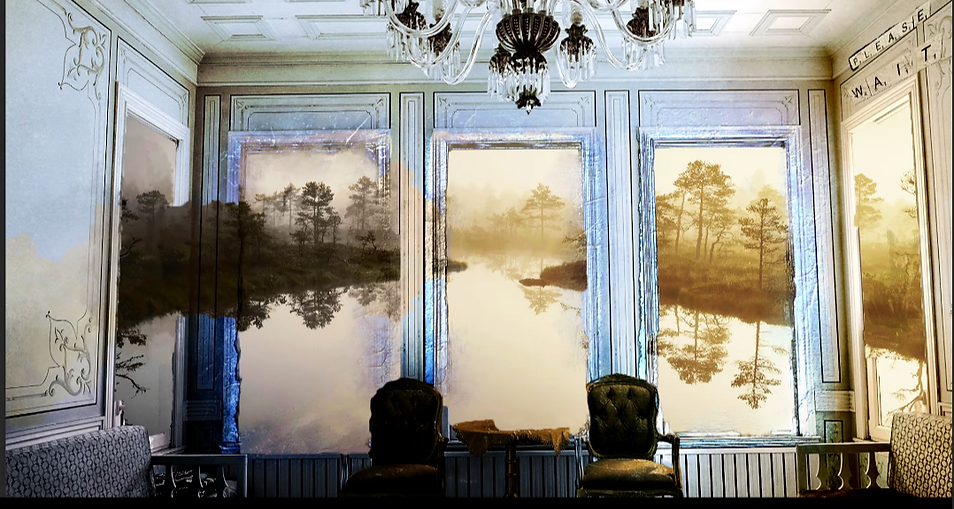
Overall contrast has increased.
OBSERVATIONS
- Contrast has been increased across the entire image.
- The chairs, lower portion of the room, and intruding landscape become noticeably darker.
- The illuminated landscape beyond the openings appears brighter by comparison.
- Architectural lines and details become more pronounced.
- The difference between the shadowed interior and glowing exterior is bigger.
- The room begins to feel heavier and more enclosed despite the brightness beyond it.
INITIAL QUESTIONS
- Does the stronger contrast make the room feel more mysterious?
- How dark should the interior become?
- Should the landscape beyond the openings feel more inviting than the room?
- Does the increased separation between light and dark help the waiting-room atmosphere?
CLASSIFICATION
Clue
NOTE
I increased the overall contrast. The darker interior against the glowing landscape gave the room more depth and made the divide between the waiting space and whatever exists beyond it feel stronger.
EVIDENCE 21.29 - breakthrough
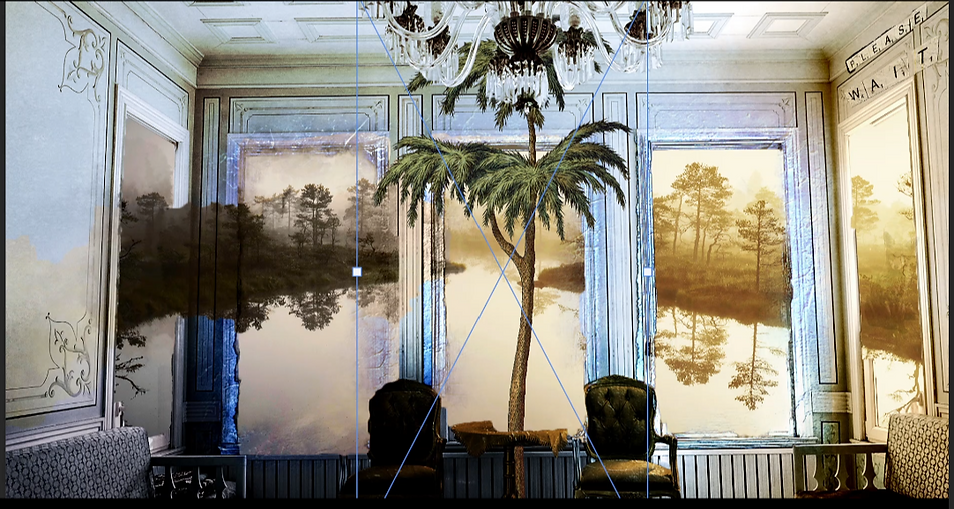
EVIDENCE 21.29
DESCRIPTION
Palm tree introduced into the room.
OBSERVATIONS
- A large palm tree has been added in front of the center opening.
- The tree currently extends from the floor almost to the ceiling and overlaps the chandelier.
- Its scale makes it feel physically present inside the room rather than part of the distant landscape.
- The palm is visually different from the trees already present in the misty landscape.
- The new element continues the idea of vegetation crossing the boundary between outside and inside.
- Its current central placement is clearly exploratory rather than resolved.
INITIAL QUESTIONS
- Does the palm belong inside the room?
- Where should the tree ultimately live?
- Can it become part of the wall rather than a freestanding object?
- How much of the tree should remain visible?
- Could this help push the landscape even farther into the architecture?
CLASSIFICATION
Breakthrough
NOTE
The placement wasn’t right yet, but the tree was. This palm would eventually move away from the center and onto the wall, becoming part of the final piece. It gave me another way to let the landscape escape its frames and enter the waiting room.
EVIDENCE 21.30 - clue

EVIDENCE 21.30
DESCRIPTION
Palm trees repositioned onto the left wall.
OBSERVATIONS
- The palm trees have been moved from the center of the room to the far-left wall.
- Their scale has been significantly reduced.
- The palms now overlap the landscape already bleeding across the wall.
- Additional dark trees have been introduced behind them, creating a denser cluster of vegetation.
- The trees appear to occupy both the architecture and the landscape at once.
- The left side of the room is beginning to feel overtaken by the world beyond the frames.
INITIAL QUESTIONS
- Do the palm trees belong here?
- How should they blend with the darker landscape behind them?
- Should they look like physical trees, shadows, or something in between?
- How far should the landscape be allowed to spread into the room?
- Is the room being invaded by the landscape, or is the room itself part of it?
CLASSIFICATION
Clue
NOTE
Moving the palms to the left wall solved the placement problem. They stopped feeling like an object standing awkwardly in the room and started becoming part of the strange overlap between the waiting room and the landscape.

EVIDENCE 21.31 - clue

EVIDENCE 21.31
DESCRIPTION
The tree cluster has blended further into the landscape.
OBSERVATIONS
- The dark trees and palms on the left have been blended more heavily into the existing landscape.
- The previously distinct tree silhouettes now feel more connected to the land beneath them.
- Darker ground has developed beneath the palms, giving the vegetation more visual weight.
- The transition between the landscape inside the frame and the landscape crossing the wall is becoming harder to locate.
- The palms remain distinct enough to introduce a different kind of vegetation into the scene.
- The left side now feels like one continuous, impossible landscape rather than several separate layers.
INITIAL QUESTIONS
- How much farther should the trees be blended?
- Should the palms remain recognizable or disappear further into the landscape?
- Where does the landscape actually begin and end now?
- Can the wall and landscape feel like the same surface?
- What is happening to the room at this boundary?
CLASSIFICATION
Clue
NOTE
I kept blending the new trees into the landscape. They were starting to feel less like separate elements I had added and more as they had grown out of whatever was happening on the left side of the room.
EVIDENCE 21.32 - clue

EVIDENCE 21.32
DESCRIPTION
The new trees have reflections.
OBSERVATIONS
- Reflections of the newly added trees now appear beneath the landscape on the left.
- The reflected forms extend downward across the wall and into the pale area below.
- The new reflections visually connect the added trees to the existing reflected landscape.
- The landscape now follows the same strange logic both inside and outside the frames.
- The reflection makes the added vegetation feel more integrated rather than simply layered over the room.
- The boundary between water, wall, window, and reflection becomes even harder to define.
INITIAL QUESTIONS
- What surface is actually reflecting these trees?
- Is there water inside the room?
- Does the reflection make the landscape feel more physically present?
- How much of the reflection should remain visible?
- Are the windows showing another place, or is that place beginning to occupy this one?
CLASSIFICATION
Clue
NOTE
I added reflections beneath the new trees so they followed the same visual rules as the original landscape. That helped them belong, but it also made the room’s geography even stranger. If the trees have reflections here, where exactly is the water?
EVIDENCE 21.33 - clue

EVIDENCE 21.33
DESCRIPTION
Painterly texture added and original seating restored.
OBSERVATIONS
- A painterly texture has been applied across the image, softening photographic detail and unifying the collage.
- The landscape, architecture, and reflections begin to feel like parts of the same visual world.
- The two center chairs have been returned to their appearance from the original room photograph.
- The benches on both sides have also been restored to their original appearance.
- Restoring the original seating makes the room feel more convincingly like a real interior despite the impossible landscape.
- The warmer chairs and benches provide contrast against the cool blue-gray architecture and pale landscape.
INITIAL QUESTIONS
- Does the painterly treatment help unify the different photographic elements?
- Do the original chairs make the room feel more believable?
- How much texture is enough before important details begin to disappear?
- Does making the furniture more ordinary make the impossible parts of the room feel stranger?
- Is the room finally beginning to feel like one place rather than a collection of separate elements?
CLASSIFICATION
Clue
NOTE
I added the painterly texture and returned the chairs and benches to the versions from the original photograph. Keeping the furniture relatively ordinary helped anchor the room while everything around it became increasingly impossible.
EVIDENCE 21.34 - clue
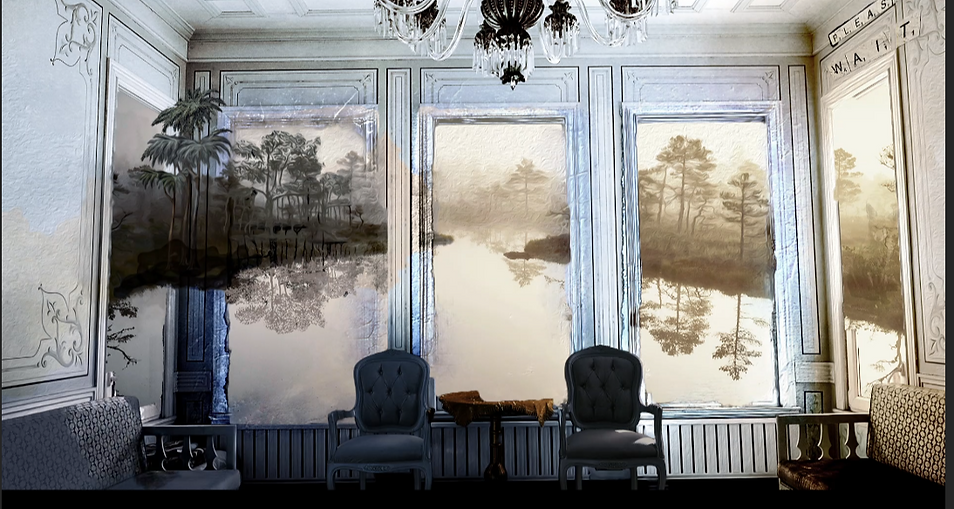
EVIDENCE 21.34
DESCRIPTION
Seating shifted back toward cool blue tones.
OBSERVATIONS
- The two center chairs have been changed from warm brown to dark blue-gray.
- The left bench has also shifted into the cooler palette.
- The right bench remains warm, creating an uneven transition across the room.
- The cooler furniture begins to connect visually with the blue-gray walls and frosted frames.
- Darkening the seating increases the contrast between the waiting area and the glowing landscape.
- The chairs become more shadowed and less inviting than in the previous version.
INITIAL QUESTIONS
- Should all of the seating move into the cooler palette?
- Are the chairs becoming too dark?
- Does the blue-gray make the waiting room feel stranger or simply colder?
- Should any warmth remain in the furniture?
- How much contrast should there be between the place you wait and the landscape beyond it?
CLASSIFICATION
Clue
NOTE
I started pulling the furniture back into the cooler palette. The warm chairs in the previous version felt a little too comfortable against everything else that was happening. Darkening them made the waiting area feel quieter and slightly less welcoming.
EVIDENCE 21.35 - clue

EVIDENCE 21.35
DESCRIPTION
The center chairs become mottled and distressed.
OBSERVATIONS
- The smooth blue-gray upholstery has been replaced by a much more irregular, weathered texture.
- The chairs now look worn, stained, or partially deteriorated.
- The left and right chairs no longer match exactly, despite being the same basic style.
- The roughened surfaces echo the distressed window frames and painterly landscape.
- The furniture feels less like ordinary seating and more like something that has been sitting here for a very long time.
- The room is beginning to feel aged in a way the original photograph did not.
INITIAL QUESTIONS
- How long has this room been here?
- Why do the chairs look more deteriorated than the architecture around them?
- Has anyone actually been sitting in them?
- Is the room aging, changing, or becoming something else?
- What exactly are these chairs waiting for?
CLASSIFICATION
Clue
NOTE
The distressed treatment finally made the chairs feel like they belonged to the same strange place as the windows, instead of looking like furniture dropped into the scene.
EVIDENCE 21.36 - clue

EVIDENCE 21.36
DESCRIPTION
A darker atmospheric layer is added across the room.
OBSERVATIONS
- Shadows deepen across the lower half of the room.
- The left side becomes considerably darker, especially around the trees and first window.
- Dark patches begin appearing along the right wall and window as well.
- The bright landscape remains visible, increasing the contrast between the room and whatever lies beyond it.
- The chairs recede further into shadow.
- The room feels less evenly lit and more enclosed.
INITIAL QUESTIONS
- Where is the darkness coming from?
- Is the room getting darker, or is the landscape getting brighter?
- Are the shadows part of the room or bleeding in from somewhere else?
- Why does the landscape seem increasingly separate from the interior?
- Is this still an ordinary room?
CLASSIFICATION
Clue
NOTE
The added darkness begins to separate the interior from the landscape. The room feels more enclosed and uncertain, while the world beyond the windows remains strangely luminous.
EVIDENCE 21.37 - clue

EVIDENCE 21.37
DESCRIPTION
The overall color balance is adjusted, cooling and darkening the interior.
OBSERVATIONS
- The chairs shift into deeper blue-black tones.
- The lower half of the room becomes darker and heavier.
- The landscape retains its warm golden light.
- The blue around the window frames becomes more pronounced.
- The contrast between the cool interior and warm exterior increases.
- The room is beginning to feel distinctly separate from the landscape.
INITIAL QUESTIONS
- Why do the interior and exterior seem to exist under different light?
- Is the landscape actually outside the room?
- Why is the room growing colder while the landscape remains warm?
- Is the separation between these two spaces significant?
CLASSIFICATION
Clue
NOTE
The cool interior and warm landscape are now functioning almost like two different environments. The windows feel less like ordinary windows and increasingly like boundaries between spaces.
EVIDENCE 21.38 - clue

EVIDENCE 21.38
DESCRIPTION
Warm light enters the upper-right portion of the room.
OBSERVATIONS
- A golden cast spreads across the ceiling and right wall.
- The right side of the room now echoes the warm tones of the landscape.
- The left side remains noticeably cooler and darker.
- The room develops a stronger cool-to-warm transition from left to right.
- The light feels less uniform and more directional.
- The “PLEASE WAIT” sign remains tucked into the upper-right corner.
INITIAL QUESTIONS
- Is the warm light coming from the landscape?
- Why does it affect only part of the room?
- Are the interior and exterior beginning to bleed into one another?
- Does the shift from cool to warm indicate two different spaces or states?
CLASSIFICATION
Clue
NOTE
The warm light begins pulling the right side of the interior toward the landscape while the left remains cool and shadowed. The room no longer seems governed by a single light source.
EVIDENCE 21.39 - dead end
EVIDENCE 21.39
DESCRIPTION
A much stronger painterly treatment is applied across the entire image.
OBSERVATIONS
- Edges throughout the room become heavily outlined and exaggerated.
- Fine details in the landscape and furniture are flattened into broader shapes.
- The trees lose some of their atmospheric softness.
- The window frames become harsher and more graphic.
- The whole image feels more illustrated than painterly.
- The subtle separation between the strange landscape and the physical room is reduced.
INITIAL QUESTIONS
- Has the texture been pushed too far?
- Is too much detail being lost?
- Does this make the room and landscape feel too similar?
- Is the atmosphere stronger or has it become too graphic?
CLASSIFICATION
Dead End
NOTE
The stronger treatment flattened too much of the image and overwhelmed some of the subtler effects that were working. The idea of a painterly finish stayed, but this version pushed it too far.

EVIDENCE 21.40 - final art

EVIDENCE 21.40
DESCRIPTION
Final art
OBSERVATIONS
- The room has settled into a cool, shadowed interior surrounding a warm, luminous landscape.
- The landscape no longer behaves entirely like a view through ordinary windows, particularly on the left where it crosses into the architecture.
- The blue, distressed window edges remain as a boundary between the interior and the landscape.
- The two central chairs face inward toward the room rather than toward the view.
- The empty chairs and benches reinforce the feeling that this is a place intended for people who are not currently there.
- “PLEASE WAIT” remains high in the upper-right corner, easy to miss at first glance.
- The final painterly treatment unifies the photographic and collage elements without erasing their strangeness.
- The room feels simultaneously abandoned, occupied, and expectant.
INITIAL QUESTIONS
- What are we waiting for?
- Who is supposed to sit in these chairs?
- Why are the chairs facing away from the extraordinary landscape?
- What happens when the waiting is over?
- Is this a waiting room, or a place between somewhere and somewhere else?
- Who put up the instruction to “PLEASE WAIT”?
CLASSIFICATION
Final Art
NOTE
The investigation ends with the room transformed into a waiting place without an obvious destination. The landscape has entered the architecture, the chairs wait for occupants, and the only instruction offered is PLEASE WAIT. Whatever happens next remains outside the frame.