


EVIDENCE 22.01 - clue

EVIDENCE 22.01
DESCRIPTION
Original architectural room with spiral columns, large arched windows, and exterior grounds visible through the openings.
OBSERVATIONS
- The room has large windows and open architectural elements, which was the original goal for the setting.
- Two spiral columns create a strong central frame, but the space between them is initially empty.
- At this stage, the architecture and exterior make spatial sense. All visible openings appear to lead to the same ordinary outdoor environment.
INITIAL QUESTIONS
- What belongs between the columns?
- What should be visible beyond the windows?
- How can this ordinary space become an impossible one?
CLASSIFICATION
Clue
NOTE
Established the original setting and spatial baseline for Case #0022.

EVIDENCE 22.02 - clue

EVIDENCE 22.02
DESCRIPTION
A second room with an old window and red couch is placed between the two spiral columns.
OBSERVATIONS
The added room creates a space within the original room.
- The columns now function as a frame or entrance into the second space.
- The red couch creates the first strong focal point and gives the otherwise empty architecture a suggestion of human presence.
INITIAL QUESTIONS
- Why is there another room inside this room?
- Who does the couch belong to?
- Where does the window in the second room lead?
CLASSIFICATION
Clue
NOTE
This is the first alteration that begins to disrupt the original room’s spatial logic.

EVIDENCE 22.03 - dead end

EVIDENCE 22.03
DESCRIPTION
The exterior landscape is replaced with an underwater environment, with a large ocean wave surrounding the room.
OBSERVATIONS
- The change immediately makes the location impossible and removes the ordinary exterior established in 22.01 and 22.02.
- The wave appears through every opening, making the entire structure seem submerged.
- The dramatic wave competes with the architecture and couch for attention rather than drawing the eye deeper into the room.
INITIAL QUESTIONS
- Is the room underwater?
- Why is the water visible through every opening?
- Is the wave helping create the mystery, or is it distracting from it?
CLASSIFICATION
Dead end
NOTE
The underwater concept made the space impossible, but the large wave was too visually dominant and took the investigation in the wrong direction.
EVIDENCE 22.04 - dead end

EVIDENCE 22.04
DESCRIPTION
The window frames on the left side are removed, leaving the ocean visible through a large open arch.
OBSERVATIONS
- Removing the window frames simplifies the architecture and gives the ocean more open space.
- The room now feels more directly exposed to the water.
- The wave remains too dominant and still makes the scene feel more like an underwater room than the strange, ambiguous space I am looking for.
INITIAL QUESTIONS
- Does removing the window help the space feel more impossible?
- Is the problem the architecture, or is it actually the wave itself?
- What would happen if the water were calmer?
CLASSIFICATION
Dead end
NOTE
Simplifying the left opening helped the composition, but it did not solve the larger problem. The wave still wasn’t working.
EVIDENCE 22.05 - clue

EVIDENCE 22.05
DESCRIPTION
The large wave is replaced with a calmer ocean and open sky visible through all three openings.
OBSERVATIONS
- The calmer water is less visually distracting than the wave and allows the architecture to become the focus again.
- Seeing the same ocean through every opening makes the room feel isolated and surrounded by water.
- The ocean begins to disrupt the spatial logic of the room without overwhelming it.
INITIAL QUESTIONS
- Where is this room if it is surrounded by ocean?
- Is the ocean outside the room, or is the room somehow inside the ocean?
- Where could any of these openings actually lead?
CLASSIFICATION
Clue
NOTE
Replacing the wave with calmer water finally worked. The ocean became part of the impossible space instead of competing with it.

EVIDENCE 22.06 - clue

EVIDENCE 22.06
DESCRIPTION
The architectural openings are cleaned up, and the missing section of the door on the right is reconstructed.
OBSERVATIONS
- Rough edges and leftover pieces from the original background are removed from the openings.
- The right-hand door is repaired so the frame reads as a complete architectural element.
- Cleaning the edges makes the ocean feel more naturally integrated into the room.
INITIAL QUESTIONS
- Does the cleaner architecture make the impossible location more believable?
- Should the open door remain an obvious possible exit?
- If every opening leads to the ocean, is there actually a way out of this room?
CLASSIFICATION
Clue
NOTE
Cleanup rather than a major compositional change, but it helped make the impossible space feel intentional and convincing.
EVIDENCE 22.07 - dead end

EVIDENCE 22.07
DESCRIPTION
A fox is placed on the red couch in the center of the room.
OBSERVATIONS
- The fox immediately becomes the main focal point of the composition.
- Its placement gives the empty couch an occupant and suggests that the animal may be important to the mystery.
- The fox draws attention away from the strange architecture and the impossible location.
INITIAL QUESTIONS
- Why is there a fox sitting on the couch?
- Does the fox belong in this room?
- Is the fox creating a mystery, or is it answering too much simply by being there?
CLASSIFICATION
Dead End
NOTE
I liked the fox, but it didn’t click. It made the piece feel like it was about the fox when the room itself was becoming more interesting.
EVIDENCE 22.08 - clue

EVIDENCE 22.08
DESCRIPTION
The fox is removed from the couch, returning the central room to an unoccupied state.
OBSERVATIONS
- Without the fox, attention returns to the couch, architecture, and ocean beyond the openings.
- The empty couch creates a stronger sense that someone or something could belong there without immediately defining who or what that is.
- Removing the fox allows the room itself to remain the primary mystery.
INITIAL QUESTIONS
- Who or what belongs in this space?
- Does the couch need an occupant at all?
- Can the absence of something become part of the mystery?
CLASSIFICATION
Clue
NOTE
Removing the fox was more useful than adding it. The empty couch reopened the question instead of answering it.
EVIDENCE 22.09 - red herring

EVIDENCE 22.09
DESCRIPTION
A woman in a dark blue gown is considered a possible occupant of the red couch.
OBSERVATIONS
- Adding a person immediately shifts the focus away from the room and toward the woman.
- Her formal clothing suggests a story about who she is and why she is there.
- The figure creates narrative possibilities, but those possibilities begin to distract from the spatial mystery already developing.
INITIAL QUESTIONS
- Who is she?
- Why is she dressed formally in this strange room?
- Is the mystery supposed to be about her, or about the place she is in?
CLASSIFICATION
Red herring
NOTE
The woman seemed promising because she gave the empty couch a possible occupant, but she pointed the investigation toward her identity and story rather than the room itself.

EVIDENCE 22.10 - red herring

EVIDENCE 22.10
DESCRIPTION
The woman in the blue gown is cut out from her original background and placed with her couch inside the central room.
OBSERVATIONS
- Placing the woman into the actual environment makes it possible to see how she interacts with the architecture and ocean.
- She becomes the dominant focal point and changes the scene from an investigation of the space into an investigation of a person.
- The woman and couch together occupy so much of the central opening that they interrupt the visual path through the room toward the ocean.
INITIAL QUESTIONS
- Is the woman too visually dominant?
- Does placing her in the room make the mystery more interesting or more obvious?
- What happens to the mystery if the room remains unoccupied?
CLASSIFICATION
Red herring
NOTE
Testing the woman in the actual room confirmed that she was leading the investigation in the wrong direction.
EVIDENCE 22.11 - red herring

EVIDENCE 22.11
DESCRIPTION
The woman in the blue gown was placed on the original red couch.
OBSERVATIONS
- Reducing her size allows more of the couch and surrounding architecture to remain visible.
- The visual path through the central room toward the window and ocean is clearer than in 22.10.
- Despite the improved scale, the woman still makes the scene feel primarily about her rather than the impossible space.
INITIAL QUESTIONS
- Does changing the woman’s scale solve the problem?
- Is the problem her size, or her presence altogether?
- Would evidence that someone had been here be more interesting than actually showing the person?
CLASSIFICATION
Red herring
NOTE
Changing the scale improved the composition, but not the mystery. The woman still pulled the investigation toward herself.
EVIDENCE 22.12 - clue
EVIDENCE 22.12
DESCRIPTION
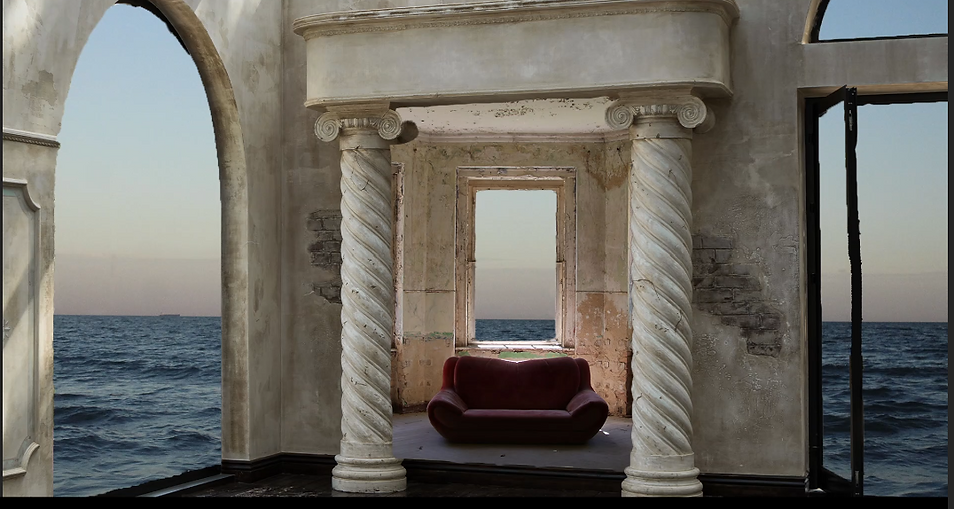
The woman is removed from the couch, returning the composition to the empty room and couch.
OBSERVATIONS
- Removing the woman shifts attention back to the architecture and the strange location.
- The empty couch feels more suggestive than an occupied one because it leaves open the possibility that someone was here.
- The composition still feels too distant, with a large amount of architecture competing with the central room.
INITIAL QUESTIONS
- Is the absence of a person more interesting than showing one?
- Can the empty couch suggest that someone was recently here?
- Would moving closer help establish a clearer focal point?
CLASSIFICATION
Clue
NOTE
Removing the woman confirmed that the mystery worked better without a visible person. The next problem became how to direct the viewer more clearly into the room.
EVIDENCE 22.13 - clue

EVIDENCE 22.13
DESCRIPTION
The overall color balance is adjusted, introducing warmer pink tones throughout the room and sky.
OBSERVATIONS
- The warmer pink cast softens the previously cool, neutral atmosphere.
- The pink tones begin to connect the sky, architecture, and red couch more cohesively.
- The warmer palette gives the room a slightly dreamlike quality without changing any of its physical elements.
INITIAL QUESTIONS
- Does the warmer color make the room feel more inviting or more uncanny?
- How much color does the architecture need?
- Can the color palette help separate this from an ordinary abandoned interior?
CLASSIFICATION
Clue
NOTE
The warmer pink color brought the separate elements closer together and began establishing the atmosphere of the finished piece.
EVIDENCE 22.14 - clue
EVIDENCE 22.14
DESCRIPTION
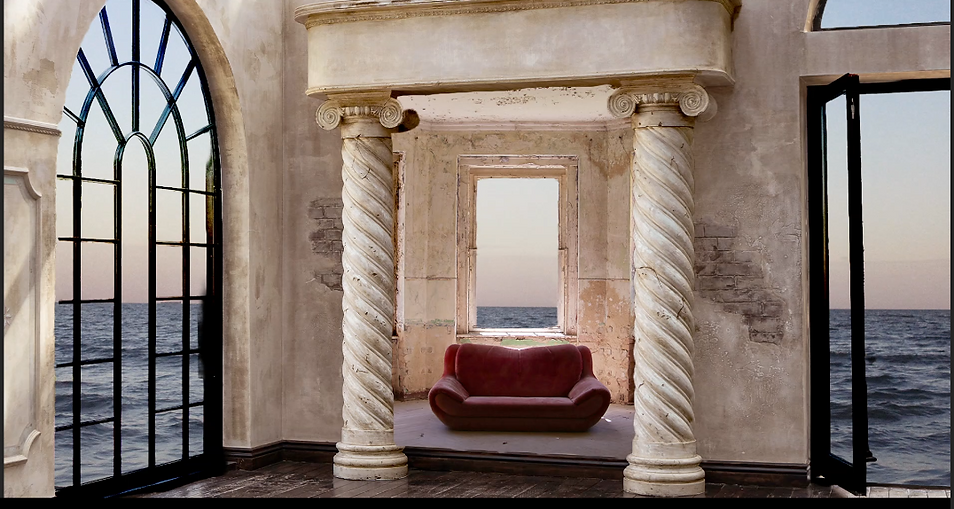
Black window frames are added back into the large left opening and reinforced around the open door on the right.
OBSERVATIONS
- The dark frames create stronger boundaries between the architecture and the ocean.
- The black lines add contrast and help define the large openings without hiding the water beyond them.
- The repeated window and door frames strengthen the sense of looking through multiple thresholds within the same space.
INITIAL QUESTIONS
- Do the frames help guide the eye through the architecture?
- Does enclosing the ocean behind frames make the room feel more believable or more impossible?
- How many thresholds does this space need?
CLASSIFICATION
Clue
NOTE
Adding the dark frames gave the outer openings more structure and helped establish the repeated doorway/window motif.
EVIDENCE 22.15 - clue

EVIDENCE 22.15
DESCRIPTION
The inner decorative sections of the left window frame are removed, simplifying the large arched opening.
OBSERVATIONS
- The simplified frame is less visually busy and allows more of the ocean and sky to remain visible.
- Removing the inner arch reduces competition between the left window and the central architecture.
- The outer frame still establishes a clear boundary between the room and the ocean.
INITIAL QUESTIONS
- Does simplifying the window help direct the eye toward the center of the composition?
- How much architectural detail is necessary around the edges?
- Is the central room becoming the clear visual destination?
CLASSIFICATION
Clue
NOTE
Simplifying the left window reduced visual competition and kept attention moving toward the central room.

EVIDENCE 22.16 - clue

c
EVIDENCE 22.17 - clue

EVIDENCE 22.17
DESCRIPTION
A green glass texture is added over the dark wooden floor.
OBSERVATIONS
- The green color begins to connect the floor with the ocean surrounding the room visually.
- The reflective glass-like areas make the floor feel less solid and more unusual.
- The change introduces uncertainty about whether the floor is simply decorative or somehow affected by the surrounding water.
INITIAL QUESTIONS
- What is the floor made of?
- Is the floor connected to the ocean outside the room?
- Can the floor help blur the boundary between inside and outside?
CLASSIFICATION
Clue
NOTE
Adding the glass texture began changing the floor from an ordinary architectural surface into part of the impossible environment.
EVIDENCE 22.18 - breakthrough

EVIDENCE 22.18
DESCRIPTION
The green glass floor is shifted to a deeper blue-green color.
OBSERVATIONS
- The blue floor visually connects much more strongly with the ocean surrounding the room.
- The darker color grounds the foreground while allowing the warmer architecture and red couch to stand out.
- The floor now feels less like a decorative effect and more like part of the strange spatial logic of the room.
INITIAL QUESTIONS
- Is the floor reflecting the ocean, or is it somehow part of it?
- Where does the interior actually end and the exterior begin?
- Can the floor help create a clearer path for the eye through the room?
CLASSIFICATION
Breakthrough
NOTE
Changing the floor from green to blue was the first breakthrough in the composition. The room finally began to feel visually connected to the water surrounding it.
EVIDENCE 22.19 - clue

EVIDENCE 22.19
DESCRIPTION
The blue-green glass floor is darkened, and the hard edge between the floor and the architecture is softened.
OBSERVATIONS
- Darkening the floor reduces its visual dominance and keeps attention on the central room and couch.
- Blurring the edge makes the transition between the floor and architecture feel less rigid.
- The floor still carries the blue-green tones of the ocean, but now works more quietly within the composition.
INITIAL QUESTIONS
- Does the darker foreground create a clearer path toward the couch and window?
- Where does the floor actually end?
- Can the boundary between the room and the water become even less certain?
CLASSIFICATION
Clue
NOTE
The blue floor worked, but it was drawing too much attention. Darkening it and softening the edge kept the effect while allowing the eye to move deeper into the room.

EVIDENCE 22.20 - clue

EVIDENCE 22.20
DESCRIPTION
The walls and architectural elements are shifted toward slightly warmer, more golden tones.
OBSERVATIONS
- The warmer color gives the architecture more richness and separates it from the cooler ocean and floor.
- The gold tones work with the pink sky and red couch, making the interior palette feel more cohesive.
- The room begins to feel less like a photograph of an abandoned building and more like a place with its own atmosphere.
INITIAL QUESTIONS
- How warm should the interior become without losing its aged quality?
- Does the contrast between the warm room and cool water strengthen the sense of inside versus outside?
- Can color help make the room feel like somewhere that exists outside ordinary reality?
CLASSIFICATION
Clue
NOTE
A small color adjustment, but the warmer walls helped give the room more atmosphere and distinguish it from the water surrounding it.

EVIDENCE 22.21 - breakthrough

DESCRIPTION
The composition is cropped significantly tighter around the central room, columns, couch, and surrounding ocean.
OBSERVATIONS
- The tighter crop removes a large amount of peripheral architecture and immediately gives the central room more visual importance.
- The columns now function as a strong frame leading directly toward the couch and the window beyond it.
- The couch is large enough to become an obvious focal point without overwhelming the architecture.
- The remaining glimpses of ocean on either side are enough to establish the impossible location without competing with the room.
INITIAL QUESTIONS
- What belongs near the couch, if anything?
- Can the eye now move naturally from the foreground to the couch and then through the window to the ocean?
- Does the composition need another focal point, or does it only need evidence that someone has been here?
CLASSIFICATION
Breakthrough
NOTE
The crop solved a problem that adding objects couldn’t. Once the excess architecture disappeared, the eye finally had a clear path into the room.
EVIDENCE 22.22 - red herring

EVIDENCE 22.22
DESCRIPTION
A large rectangular gold-textured object is placed in front of the couch in the center of the room.
OBSERVATIONS
- The gold introduces a strong new color and texture into the composition.
- Its size and brightness immediately make it the dominant focal point.
- The object blocks most of the couch and interrupts the visual path from the foreground through the couch toward the window and ocean.
- Instead of adding intrigue to the room, it creates a new question that feels disconnected from the mystery already developing.
INITIAL QUESTIONS
- What is this object supposed to be?
- Why is it here?
- Is it adding to the mystery or simply creating another competing focal point?
CLASSIFICATION
Red herring
NOTE
The gold initially seemed like it might give the room the strange focal point it needed, but it took over the composition. Instead of leading the eye deeper into the room, it became the destination.

EVIDENCE 22.23 - red herring

EVIDENCE 22.23
DESCRIPTION
The gold texture is reshaped to match the form of the couch beneath it.
OBSERVATIONS
- Shaping the gold like the couch integrates it into the room better than the rectangular version.
- The familiar couch silhouette makes the gold object feel intentional rather than randomly placed.
- The metallic surface is still extremely visually dominant and pulls attention away from the surrounding architecture.
- The experiment suggests that altering the couch itself could work, but gold is not the answer.
INITIAL QUESTIONS
- Could the couch become something other than an ordinary piece of furniture?
- Is changing the couch itself a better direction than adding another object?
- What kind of transformation would add strangeness without overpowering the room?
CLASSIFICATION
Red Herring
NOTE
Reshaping the gold to follow the couch made the idea more convincing, but not more useful. It suggested that the couch itself could be transformed, even though turning it gold was the wrong direction.
EVIDENCE 22.24 - red herring

EVIDENCE 22.24
DESCRIPTION
The gold texture is blended into the couch so that the couch itself appears to be made of reflective gold.
OBSERVATIONS
- The shape and details of the couch are now clearly visible beneath the gold texture.
- The transformation feels more integrated than the previous gold experiments because the couch remains recognizable.
- The brightness of the gold makes the couch overwhelmingly dominant and pulls the eye directly to it.
- Instead of making the room stranger, the gold couch feels like the explanation for why the viewer should be looking there.
INITIAL QUESTIONS
- Is the couch supposed to be the mystery?
- Does making it extraordinary actually make the rest of the room feel more ordinary?
- Would the original red couch create more unanswered questions?
CLASSIFICATION
Red Herring
NOTE
This finally made the gold-couch idea work technically, but it confirmed that gold was the wrong direction. The couch became too important.
EVIDENCE 22.25 - clue

EVIDENCE 22.25
DESCRIPTION
The gold treatment is abandoned, and the couch is returned to its original deep red color.
OBSERVATIONS
- The red couch provides a strong focal point without overwhelming the architecture around it.
- Returning to red restores the contrast between the warm interior, cool ocean, and dark blue-green floor.
- The couch once again feels like something that belongs in the room rather than the explanation for the room.
- Attention can move from the couch upward through the window and out toward the horizon.
INITIAL QUESTIONS
- If the couch itself doesn’t need to be strange, what does?
- Does the ordinary couch make the impossible location feel stranger?
- What small detail could suggest that someone has recently been here without showing them?
CLASSIFICATION
Clue
NOTE
The gold experiments confirmed that the couch didn’t need to become extraordinary. Returning it to red made the room stranger by contrast: an ordinary couch sitting somewhere it absolutely shouldn’t be.
EVIDENCE 22.26 - breakthrough

EVIDENCE 22.26
DESCRIPTION
The ocean is shifted dramatically toward a bright turquoise-green.
OBSERVATIONS
- The altered color immediately makes the surrounding water feel less familiar and more otherworldly.
- The turquoise contrasts strongly with the warm gold and pink tones of the architecture.
- The ocean now feels visually connected to the blue-green floor while remaining much brighter.
- The room no longer appears to be sitting beside an ordinary ocean. The surrounding environment itself begins to feel impossible.
INITIAL QUESTIONS
- Is this still an ocean as we understand it?
- Has the room changed, or has the world outside it changed?
- Can an otherwise recognizable place feel completely unfamiliar because of color alone?
CLASSIFICATION
Breakthrough
NOTE
Changing the water transformed the atmosphere of the entire piece. The ocean stopped behaving like background scenery and became part of the impossibility.

EVIDENCE 22.27 - clue

EVIDENCE 22.27
DESCRIPTION
The turquoise ocean is softened and desaturated, shifting toward a paler blue-green.
OBSERVATIONS
- The water retains the unusual blue-green cast established in 22.26 without being as intensely bright.
- Reducing the saturation keeps the ocean from competing with the red couch for attention.
- The cooler water still contrasts with the warm gold and pink architecture.
- The ocean now feels strange without announcing its strangeness quite so loudly.
INITIAL QUESTIONS
- How unnatural can the water feel while still reading as real water?
- Does the quieter turquoise make the impossible setting more convincing?
- Is the ocean now supporting the room rather than competing with it?
CLASSIFICATION
Clue
NOTE
The breakthrough was the turquoise water. This adjustment refined it. Pulling the color back kept the strange quality while keeping the room and couch as the primary focus.
EVIDENCE 22.28 - clue

EVIDENCE 22.28
DESCRIPTION
The blue-green glass floor is extended into the central room beneath and around the couch.
OBSERVATIONS
- The floor now appears to continue past the columns instead of stopping at the threshold.
- Extending the blue-green surface connects the foreground more strongly to the couch and central room.
- The darker area beneath the couch creates depth and anchors it within the composition.
- The distinction between the outer room and the inner room becomes less certain.
INITIAL QUESTIONS
- Is this one continuous floor running through both spaces?
- How far does the blue-green surface extend into the room?
- Is the floor reflecting the strange ocean, or is something else happening beneath it?
CLASSIFICATION
Clue
NOTE
Extending the floor into the central room helped connect the two spaces. The threshold between them became less definite, making it harder to tell where one space ends and another begins.
EVIDENCE 22.29 - clue

EVIDENCE 22.29
DESCRIPTION
A tall metal window frame is added back into the large arched opening on the left.
OBSERVATIONS
- The frame gives the left opening more architectural structure while preserving the view of the ocean.
- Its thin vertical lines contrast with the heavy spiral columns in the center.
- The warm metallic tones connect with the increasingly golden architecture without creating the visual weight of the earlier black frame.
- The frame creates another layer to look through, reinforcing the repeated thresholds already present in the room.
INITIAL QUESTIONS
- Does the frame make the left opening feel more like part of the room?
- Do the repeated openings create a stronger path through the space?
- How many architectural layers can the viewer look through before the space stops making logical sense?
CLASSIFICATION
Clue
NOTE
Bringing the frame back worked once it was lighter and warmer. Instead of competing with the central room, it added another threshold to the impossible architecture.
EVIDENCE 22.30 - clue

EVIDENCE 22.30
DESCRIPTION
A teacup and saucer are placed on the floor near the left window.
OBSERVATIONS
- The teacup introduces the first clear evidence of a human presence without actually showing a person.
- Its placement on the floor feels slightly unusual, suggesting it was left there rather than deliberately displayed.
- The cup is small enough that it doesn’t compete with the couch or central architecture.
- It gives the viewer something to discover after taking in the larger scene.
INITIAL QUESTIONS
- Who left the teacup here?
- Why was it left on the floor?
- How recently was someone in this room?
- Where did they go?
CLASSIFICATION
Clue
NOTE
The teacup did what the woman couldn’t. It introduced a person into the story without showing them.
EVIDENCE 22.31 - clue

EVIDENCE 22.31
DESCRIPTION
Steam rises from the teacup, curling upward against the wall.
OBSERVATIONS
- The steam changes the teacup from evidence that someone was here to evidence that someone was here very recently.
- Its exaggerated curling shape introduces movement into an otherwise still room.
- The pale blue-green steam connects visually with the ocean and glass floor.
- The steam draws the eye down toward the small teacup after the larger architecture and couch have been noticed.
INITIAL QUESTIONS
- Who was drinking the tea?
- How recently did they leave?
- Why would someone leave a hot cup of tea on the floor?
- Did they leave voluntarily?
CLASSIFICATION
Clue
NOTE
The steam on the teacup gave it a sense of time. Whoever was here didn’t leave long ago.
EVIDENCE 22.32 - clue

EVIDENCE 22.32
DESCRIPTION
The steam rising from the teacup is less opaque and blends more softly into the surrounding wall.
OBSERVATIONS
- The steam is now subtle enough that it has to be discovered rather than immediately noticed.
- Its softer appearance feels more like actual steam while retaining the unusual curling shape.
- The teacup remains evidence of recent human presence without becoming a major focal point.
- The steam creates a quiet secondary detail after the viewer has taken in the couch, architecture, and ocean.
INITIAL QUESTIONS
- How recently was the tea abandoned?
- Who left it here?
- Why is the cup on the floor rather than beside the couch?
- What made its owner leave before the tea went cold?
CLASSIFICATION
Clue
NOTE
The steam worked better once it became something the viewer could almost miss. The evidence of a recent presence is still there, but now it has to be found.
EVIDENCE 22.33 - clue

EVIDENCE 22.33
DESCRIPTION
A pair of red high-heeled shoes is placed on the floor near the teacup.
OBSERVATIONS
- The shoes introduce a second trace of an absent person without requiring a visible figure.
- Their red color echoes the couch, creating a visual connection between the foreground and the center of the room.
- Together, the shoes and steaming teacup make the human absence feel more deliberate and more recent.
- The placement suggests someone removed the shoes and left them behind rather than the shoes simply being stored there.
INITIAL QUESTIONS
- Who left the shoes beside the teacup?
- Why did they take them off?
- Where is their owner now?
- Did the person who left the tea also leave the shoes?
CLASSIFICATION
Clue
NOTE
The shoes strengthened the idea that someone was here without putting the person into the image. Unlike the woman, their absence creates more questions than their presence would answer.
EVIDENCE 22.34 - clue

EVIDENCE 22.34
DESCRIPTION
The red shoes are darkened to a deeper burgundy and blended more closely with the room lighting.
OBSERVATIONS
- Darkening the shoes keeps them from competing with the red couch as the primary color focal point.
- The shoes now feel more naturally embedded in the shadowed foreground.
- Their connection to the couch remains through the shared red tones, but it is subtler.
- The teacup and shoes now read as details to discover rather than objects demanding immediate attention.
INITIAL QUESTIONS
- Who left the shoes here?
- Were they removed casually, or was their owner interrupted?
- Why were both the shoes and a still-warm cup of tea abandoned?
- Where did their owner go?
CLASSIFICATION
Clue
NOTE
The shoes worked better once they stopped shouting. Darkening them kept the evidence of the missing person while allowing the viewer to discover it after entering the room visually.
EVIDENCE 22.35 - clue

EVIDENCE 22.35
DESCRIPTION
A painterly treatment is applied across the entire image, softening photographic detail and unifying the separate elements.
OBSERVATIONS
- The room, ocean, couch, shoes, and teacup now share the same visual texture.
- Hard photographic edges are softened, making the constructed space feel more cohesive.
- The warmer walls become richer and more atmospheric under the treatment.
- The darker foreground creates greater depth and pulls attention toward the illuminated central room.
- The surreal elements feel less like separate additions and more like parts of the same impossible place.
INITIAL QUESTIONS
- Does the room now feel like a real place despite its impossible location?
- Does the softened texture make the scene feel remembered rather than observed?
- Is this somewhere that exists physically, or somewhere that can only be encountered?
CLASSIFICATION
Clue
NOTE
The painterly treatment finally begins pulling all the separate pieces into one world. The room feels less assembled and more like a place that was already there.

EVIDENCE 22.36 - final art

EVIDENCE 22.36
DESCRIPTION
Final artwork. Golden, luminous particles rise from the teacup beside the abandoned red shoes while the empty couch remains surrounded by ocean.
OBSERVATIONS
- The teacup now appears to be producing something that behaves more like light or energy than ordinary steam.
- The rising particles spread upward along the wall rather than dissipating immediately.
- The shoes and teacup remain the only direct evidence of a person, but no person is present.
- The couch is empty.
- The surrounding ocean makes ordinary entry into or exit from the room difficult to explain.
- The warm golden interior contrasts with the strange blue-green water and dark floor.
- The room feels recently occupied rather than abandoned.
INITIAL QUESTIONS
- Who was here?
- Where did they go?
- How did they leave?
- What is rising from the cup?
- Were the shoes removed voluntarily?
- Is the room isolated by the ocean, or is the ocean part of the room itself?
CLASSIFICATION
Final art
NOTE
The scene no longer feels empty. It feels vacated. Someone was here recently enough to leave evidence behind, but there is no obvious way for them to have gone anywhere.