


Field
Investigators
Home
About
Case Archive


EVIDENCE 20.01 - clue

EVIDENCE 20.01
DESCRIPTION
A pale, nearly washed-out seascape with calm water and a faint horizon.
OBSERVATIONS
-The image is extremely bright and low-contrast.
-The horizon divides the scene into open sky and water.
-A few distant ships are barely visible.
-There is no obvious subject or focal point.
INITIAL QUESTIONS
-Where is this?
-What belongs here?
-Is the emptiness important?
CLASSIFICATION
Clue
NOTE
This is where the investigation began. No mystery had revealed itself yet.

EVIDENCE 20.02 - clue

EVIDENCE 20.02
DESCRIPTION
A dark, columned interior with two ornate chandeliers and a closed door was added over the seascape.
OBSERVATIONS
-The architecture creates a strong central corridor leading directly to the closed door.
-The ocean remains visible on both sides, making it unclear whether the structure is indoors, outdoors, or somehow occupying the water.
-The chandeliers introduce an unexpectedly formal, almost grand atmosphere.
INITIAL QUESTIONS
-Why is this room here?
-Is the ocean outside the structure, or is the structure standing in the ocean?
-Where does the closed door lead?
CLASSIFICATION
Clue
NOTE
The empty seascape now has a destination. The first contradiction between interior and exterior has appeared.

EVIDENCE 20.03 - clue

EVIDENCE 20.03
DESCRIPTION
The ornate interior was replaced with a weathered concrete structure made of repeating columns.
OBSERVATIONS
-The repeating columns create a strong tunnel effect and pull the eye toward the center.
-The structure feels industrial and abandoned rather than formal or inhabited.
-The faded blue, rust, and exposed concrete give the scene a colder, more weathered atmosphere.
-The markings on the left column look like measurements for recorded water levels.
INITIAL QUESTIONS
-What is this structure?
-Where does the passage lead?
-What do the markings on the column measure?
-Has water been here before?
CLASSIFICATION
Clue
NOTE
The location changed completely, but the idea of a passage or threshold remained.
EVIDENCE 20.04 dead end

EVIDENCE 20.04
DESCRIPTION
The concrete structure was removed, returning the composition to the original seascape.
OBSERVATIONS
-The image is once again almost entirely open water and sky.
-The strong central perspective created by the columns is gone.
-The composition feels calmer, but also empty again.
-The removal suggests the concrete structure was not the right setting.
INITIAL QUESTIONS
-What should occupy this space?
-Does the water need a structure at all?
-What kind of place belongs here?
CLASSIFICATION
Dead end
NOTE
The concrete structure was abandoned, and the investigation returned to its starting point.

EVIDENCE 20.05 - clue

EVIDENCE 20.05
DESCRIPTION
The previous architectural elements were layered together: the ocean in the background, the weathered concrete columns in front of it, and the dark green interior with its chandelier and closed door in the foreground.
OBSERVATIONS
-The image now contains multiple distinct spaces layered on top of one another.
-The weathered columns create a transition between the ocean and the more formal interior.
-The closed door remains centered and becomes a strong destination point.
-The contrast between the decaying concrete and the ornate chandelier makes the location harder to define rather than clearer.
-The ocean is still visible beyond everything, keeping the exterior landscape connected to the interior.
INITIAL QUESTIONS
-Are these separate places or parts of the same place?
-Are we inside or outside?
-Which layer is the actual location?
-Where does the closed door lead?
CLASSIFICATION
Clue
NOTE
Instead of choosing between the two structures, they were combined. This is the first version where the location begins to feel deliberately impossible.
EVIDENCE 20.06 - clue

EVIDENCE 20.06
DESCRIPTION
The layers were rearranged and masked so the weathered concrete structure surrounds the green interior, while the ocean remains visible behind both.
OBSERVATIONS
-The concrete columns now frame the green interior rather than simply sitting behind it.
-The chandelier extends beyond the interior space and into the concrete structure.
-The closed door remains centered and continues to pull the eye inward.
-The irregular masking makes the different spaces appear to be merging rather than existing as clean, separate layers.
-The ocean is visible around the architecture, further confusing where the structure actually exists.
INITIAL QUESTIONS
-How many places are we looking at?
-Is one space appearing inside another?
-Is the door an entrance, an exit, or another layer entirely?
-Which space are we actually standing in?
CLASSIFICATION
Clue
NOTE
The boundaries between the locations began to break down. Instead of one setting in front of another, the spaces started occupying each other.

EVIDENCE 20.07 - dead end

EVIDENCE 20.07
DESCRIPTION
All architectural elements were removed again, returning the composition to the original seascape.
OBSERVATIONS
-The layered architecture had become too complicated.
-The different structures were competing with one another instead of creating a convincing shared space.
-Removing everything restored the openness and simplicity of the original image.
-The investigation was back at its starting point for the second time.
INITIAL QUESTIONS
-What was making the previous version feel too complicated?
-Which elements are actually worth keeping?
-Can the same idea be built more simply?
CLASSIFICATION
Dead end
NOTE
The layered approach became too fussy. Everything except the ocean was removed so the composition could be rebuilt more simply.
EVIDENCE 20.08 - clue

EVIDENCE 20.08
DESCRIPTION
The dark green interior with its columns, chandelier, and closed door was returned to the center of the seascape.
OBSERVATIONS
-The interior is now isolated rather than combined with the weathered concrete structure.
-The ocean remains fully visible on either side of the room.
-The simpler composition makes the contrast between the formal interior and open water much clearer.
-The closed door again creates a strong central destination.
-The chandelier gives the interior a sense of grandeur that feels strange against the quiet ocean.
INITIAL QUESTIONS
-Is this room standing in the ocean?
-Does the door lead somewhere else?
-Why does this version feel more convincing with fewer elements?
CLASSIFICATION
Clue
NOTE
The green interior survived the reset. Removing the additional architecture made the central idea easier to read.
EVIDENCE 20.09 - clue

EVIDENCE 20.09
DESCRIPTION
The interior structure was removed, leaving one of its ornate chandeliers suspended above the ocean.
OBSERVATIONS
-The chandelier remains even though the room that supported it is gone.
-It creates the first clearly impossible object in the otherwise ordinary seascape.
-The chandelier and ocean feel as though they belong to two completely different locations.
-Removing the architecture makes the chandelier itself much more noticeable.
INITIAL QUESTIONS
-What is the chandelier hanging from?
-Why did the chandelier survive when the room did not?
-Are pieces of one place beginning to appear in another?
CLASSIFICATION
Clue
NOTE
I liked the chandelier more than I liked the room it came with. It was worth seeing what happened if I kept it on its own.
EVIDENCE 20.10 - clue

EVIDENCE 20.10
DESCRIPTION
The weathered concrete structure was brought back and blended into the seascape beneath the chandelier.
OBSERVATIONS
-The concrete structure is much lighter and more transparent than before.
-The ocean remains visible through the columns, making the water and architecture appear to occupy the same space.
-The chandelier now hangs within the overlapping seascape and structure.
-The boundaries between indoors, outdoors, water, and architecture are becoming less distinct.
INITIAL QUESTIONS
-Is the structure emerging from the water or dissolving into it?
-Are we looking at one place or several places overlapping?
-How much of the architecture needs to remain visible?
CLASSIFICATION
Clue
NOTE
I still liked the weathered columns. The problem before wasn’t necessarily the structure itself, but how solid and separate everything felt. Blending it into the ocean felt more interesting.

EVIDENCE 20.11 - clue

EVIDENCE 20.11
DESCRIPTION
A weathered doorway leading into a sand-filled room was added at the center of the concrete structure.
OBSERVATIONS
-The doorway creates a strong focal point and gives the surrounding columns a destination.
-Sand now appears inside the architecture while ocean water remains outside it.
-The warm gold and rust tones of the doorway contrast with the pale blue ocean and concrete.
-The chandelier appears to hang directly above the entrance, visually connecting it to the doorway.
-The composition now contains water, concrete architecture, an interior room, and sand within the same location.
INITIAL QUESTIONS
-Where does this doorway lead?
-Why is there sand inside the room?
-Is the room connected to the beach or somewhere else entirely?
-Are these different locations beginning to connect?
CLASSIFICATION
clue
NOTE
I wanted something warmer and more inviting in the center. The doorway gave my eye somewhere to go, and I liked the idea that there might be yet another place beyond it.
EVIDENCE 20.12 - clue

EVIDENCE 20.12
DESCRIPTION
The sand-filled room was removed from inside the doorway, leaving the weathered doorframe open to the repeating concrete columns beyond it.
OBSERVATIONS
-The doorway now frames the existing structure instead of introducing another separate room.
-The repeating columns continue through the doorway, creating much greater depth.
-The ocean, doorway, and concrete structure begin to feel more connected rather than stacked together.
-The warm doorway remains a strong contrast against the cool, faded surroundings.
-The open doorway makes the destination less certain than the enclosed room did.
INITIAL QUESTIONS
-Is the doorway part of this structure or an entrance into it?
-How far does the passage continue?
-Does the doorway actually lead anywhere?
-Are we moving deeper into the same place or into another one?
CLASSIFICATION
Clue
NOTE
The sand-filled room felt like one place too many. I liked the doorway itself much more, especially once I could see the repeating columns through it.
EVIDENCE 20.13 - clue

EVIDENCE 20.13
DESCRIPTION
The ocean was moved forward in the composition so that it now passes across the weathered columns and doorway.
OBSERVATIONS
-The water now clearly overlaps the architecture instead of sitting behind it.
-The lower portions of the columns appear submerged.
-The doorway seems to begin above the waterline, making its relationship to the surrounding structure stranger.
-The boundary between the seascape and architecture is much less distinct.
-The scene is beginning to read as a flooded or partially submerged place.
INITIAL QUESTIONS
-How deep is the water?
-Is this structure flooded, or has it always existed in the water?
-How would anyone reach the doorway?
-Are we still looking at an interior space?
CLASSIFICATION
Clue
NOTE
Putting the ocean in front changed everything. Instead of looking through the architecture toward the water, I was suddenly looking at a place that the water had entered.
EVIDENCE 20.14 - clue

EVIDENCE 20.14
DESCRIPTION
The water-level measurement markings were removed from the left concrete column.
OBSERVATIONS
-The left column is less visually busy without the numbered markings.
-The weathered stains and discoloration become more prominent.
-The structure feels less specifically documented or identifiable without the measurements.
-The removal keeps attention on the doorway, chandelier, and water rather than on the writing.
INITIAL QUESTIONS
-Does removing the measurements make the location feel less specific?
-Are the weathered surfaces enough to suggest the structure’s history?
-What details actually matter to this place?
CLASSIFICATION
clue
NOTE
The measurements were interesting, but they were starting to feel like a clue I didn’t actually want the viewer to follow. Removing them simplified the column and kept the mystery focused elsewhere.

EVIDENCE 20.15 - clue

EVIDENCE 20.15
DESCRIPTION
A textured, painterly layer was added across the composition, and the overall color and contrast were warmed and deepened.
OBSERVATIONS
-The chandelier and doorway become richer and more golden.
-The rust and weathering on the columns are more pronounced.
-The ocean loses some of its clean photographic quality and begins to blend visually with the architecture.
-The added surface texture helps the separate source images feel more like parts of the same environment.
-The scene feels older and less literal.
INITIAL QUESTIONS
-Is this starting to feel like one place?
-How much texture is enough before details begin to disappear?
-Does the warmer atmosphere help connect the otherwise unrelated elements?
CLASSIFICATION
Clue
NOTE
The pieces were working together compositionally, but they still felt like separate photographs. I wanted to start pulling them into the same visual world.
EVIDENCE 20.16 - clue

EVIDENCE 20.16
DESCRIPTION
The texture was softened, and the overall palette was lightened, giving the scene a warmer, hazier appearance.
OBSERVATIONS
-The ocean and architecture blend more gently into one another.
-The heavy surface texture from the previous version is less noticeable.
-The warm rust and gold tones remain, but the scene feels brighter and less dense.
-The doorway and chandelier stand out more clearly against the softened surroundings.
-The structure appears increasingly faded or dreamlike rather than physically solid.
INITIAL QUESTIONS
-Should the architecture feel solid or partially dissolved?
-Does the softer treatment make the different spaces feel more connected?
-How much of the original seascape should remain recognizable?
CLASSIFICATION
Clue
NOTE
The previous version felt a little too heavy. I liked the texture, but I didn’t want it to be the first thing I noticed. Softening it let the strange geography come forward again.
EVIDENCE 20.17 - clue

EVIDENCE 20.17
DESCRIPTION
The warm gold color of the doorway was reduced, shifting it toward a more muted, weathered tone.
OBSERVATIONS
-The doorway no longer stands apart from the concrete structure as strongly.
-The chandelier becomes the primary source of warm gold in the composition.
-The more neutral doorway helps the architecture feel like one continuous environment.
-The overall scene feels quieter and more aged.
-The eye is pulled through the doorway rather than stopping at its frame.
INITIAL QUESTIONS
-Does the doorway need to stand out, or should it disappear into the structure?
-Where should the strongest warm color be concentrated?
-Is the chandelier becoming the visual anchor?
CLASSIFICATION
Clue
NOTE
The gold doorway was competing with the chandelier. Muting it gave the chandelier more room to do its job and made the doorway feel like part of the place, not an object pasted onto it.
EVIDENCE 20.18 - clue

EVIDENCE 20.18
DESCRIPTION
A large red fox was added to the center of the composition, sitting in the water directly in front of the doorway.
OBSERVATIONS
-The fox immediately becomes the dominant focal point because of its size, color, and direct gaze.
-The warm orange fur echoes the gold and rust tones already present in the architecture.
-The fox blocks much of the doorway and chandelier, interrupting the depth of the central passage.
-Its placement in the water introduces a living subject.
-The scale of the fox feels exaggerated compared with the surrounding architecture.
INITIAL QUESTIONS
-Why is there a fox here?
-Does the fox belong in this place?
-Is the fox too large?
-Should the fox be the subject of the mystery, or part of the environment?
CLASSIFICATION
Clue
NOTE
I wanted a subject, and apparently the investigation produced a fox. I liked the direct stare and the orange against all that pale blue, but at this size he completely took over the image.
EVIDENCE 20.19 - red herring

EVIDENCE 20.19
DESCRIPTION
The doorway was changed from weathered gold to a deep blue.
OBSERVATIONS
-The blue doorway creates much stronger contrast against the pale architecture.
-The chandelier becomes even warmer by comparison.
-The doorway immediately attracts attention and begins competing with the chandelier.
-The blue suggests the doorway might become an important visual element.
-The fox is still faintly visible within the passage, but no longer dominates the composition.
INITIAL QUESTIONS
-Should the doorway become a stronger focal point?
-Does the blue help define the different spaces or separate them too much?
-Is the doorway actually important enough to deserve this much attention?
CLASSIFICATION
Red herring
NOTE
For a moment, I thought the doorway needed more color and more importance. The blue made it look significant, but it was pulling the investigation in the wrong direction.

EVIDENCE 20.20 - red herring

EVIDENCE 20.20
DESCRIPTION
The blue doorway was enlarged and extended downward into the water, creating a tall freestanding frame in the center of the composition.
OBSERVATIONS
-The doorway now extends from the architecture into the ocean.
-The waterline passes directly through the frame, further mixing interior and exterior space.
-The enlarged blue frame becomes one of the strongest visual elements in the image.
-The open center creates the impression of a portal or passage standing in the water.
-The doorway now feels more important than the surrounding architecture.
INITIAL QUESTIONS
-Is this doorway a portal between places?
-Should the door become the central mystery?
-What exists on the other side?
-Is the frame helping connect the different spaces, or drawing too much attention to itself?
CLASSIFICATION
Red herring
NOTE
I was definitely chasing the doorway here. Making it larger made the portal idea even stronger, but that wasn’t ultimately where the piece wanted to go.

EVIDENCE 20.21 - red herring

EVIDENCE 20.21
DESCRIPTION
The enlarged blue doorway was partially dissolved into the surrounding architecture and water, softening the hard edges of the frame.
OBSERVATIONS
-The doorway no longer extends as a solid structure all the way into the foreground.
-The lower portion appears to fade into the water.
-The blue frame remains visually prominent despite being softened.
-The blending makes the doorway feel more atmospheric and portal-like.
-The chandelier still anchors the center above the opening.
INITIAL QUESTIONS
-Can the doorway work if it feels less physically solid?
-Is the problem the doorway itself or how strongly it is being emphasized?
-Does dissolving the frame make the transition between places more convincing?
CLASSIFICATION
Red herring
NOTE
I was still trying to make the blue doorway work. Softening and dissolving it helped integrate it, but I was solving the wrong problem. The doorway didn’t need a better treatment. It needed to stop being the main event.
EVIDENCE 20.22 - clue

EVIDENCE 20.22
DESCRIPTION
The blue doorway treatment was abandoned, returning the frame to a muted, weathered tone. The ocean was darkened and given more contrast.
OBSERVATIONS
-The doorway recedes into the architecture instead of demanding attention.
-The chandelier once again becomes the strongest warm element in the center.
-The darker water gives the lower half of the image more visual weight.
-The submerged columns are easier to distinguish against the deeper blue water.
-The architecture, doorway, and ocean feel more unified than they did during the blue-door experiments.
INITIAL QUESTIONS
-Is the doorway finally supporting the scene instead of controlling it?
-Does the darker water give the image enough depth?
-What does the composition still need as a focal point?
-If the doorway isn’t the subject, what is?
CLASSIFICATION
Clue
NOTE
I stopped trying to make the doorway important. Once I let it fall back into the structure, I could see the bigger problem again: the setting was starting to work, but I still didn’t really have a story.
EVIDENCE 20.23 - clue

EVIDENCE 20.23
DESCRIPTION
A large, ornate gallery with a long central perspective was introduced as a possible replacement for the existing architecture.
OBSERVATIONS
-The gallery creates an extremely strong vanishing point at the center of the image.
-The repeating windows, columns, and ceiling details create much greater depth than the previous structure.
-The bright white architecture is dramatically different from the weathered, industrial setting used so far.
-The polished dark floor creates strong reflections and could potentially interact with the water.
-The scale of the space makes the location feel grand and monumental.
INITIAL QUESTIONS
-Could this become the new setting?
-Would the ocean work inside this space?
-Is the gallery too grand or too clean for the direction the case has taken?
-What would happen if this interior were combined with the existing elements?
CLASSIFICATION
Clue
NOTE
I still wasn’t satisfied with the setting, so I started looking for another kind of interior. I liked the depth and the reflections here enough to see where it might lead.
EVIDENCE 20.24 - clue

EVIDENCE 20.24
DESCRIPTION
The ornate gallery combined with the ocean and chandelier created a flooded interior with a small doorway at the far end.
OBSERVATIONS
-The ocean now appears to flow directly through the gallery.
-The dark reflective floor and water blend surprisingly well.
-The chandelier feels at home in the ornate architecture, making that part of the scene more believable.
-The distant doorway creates a strong focal point at the end of the gallery.
-The scene now reads clearly as an interior and a seascape at the same time.
-The strong central perspective makes the space feel enormous.
INITIAL QUESTIONS
-Is the gallery flooded, or is the ocean simply part of it?
-Where does the distant doorway lead?
-Are we indoors, outdoors, or somewhere that can be both?
-Is this finally the place we’ve been looking for?
CLASSIFICATION
Clue
NOTE
This worked much better than I expected. The water and reflective floor almost belonged together, and for the first time the impossible geography felt convincing instead of simply layered.
EVIDENCE 20.25 - clue

EVIDENCE 20.25
DESCRIPTION
The upper portion of the gallery was darkened with a cool blue-gray tone, increasing the contrast between the ceiling and the bright lower walls.
OBSERVATIONS
-The darker ceiling gives the gallery more depth and makes the architecture feel less washed out.
-The chandelier stands out more strongly against the darker area behind it.
-The cool blue-gray begins connecting the upper architecture visually with the water below.
-The center remains bright, continuing to pull the eye toward the distant doorway.
-The space feels moodier and less pristine than the previous version.
INITIAL QUESTIONS
-How dark should this place become?
-Does the cooler ceiling make the water and architecture feel more connected?
-Should the distant doorway remain the destination?
-What else does this place need before it feels inhabited?
CLASSIFICATION
Clue
NOTE
The gallery was working, but it felt too bright and pristine. Darkening the upper architecture gave it some atmosphere and helped the chandelier stand out without changing the strange geography I liked.
EVIDENCE 20.26 - clue

EVIDENCE 20.26
DESCRIPTION
A small weathered boat was added to the left side of the flooded gallery.
OBSERVATIONS
-The boat introduces the first object that suggests someone could actually move through this place.
-Its warm orange-brown color creates a strong focal point against the cool blue water and pale architecture.
-The boat breaks the gallery’s rigid symmetry and shifts visual weight toward the left.
-Its presence makes the water feel less decorative and more physically real.
-The scale of the boat emphasizes how enormous the gallery is.
-The distant doorway now feels less like the only possible destination.
INITIAL QUESTIONS
-Who does the boat belong to?
-How did it get inside the gallery?
-Is it meant to take someone somewhere?
-If there’s a boat here, how far does this water go?
CLASSIFICATION
Clue
NOTE
The setting finally had a place, but it still didn’t have much of a story. The boat changed that. Suddenly this wasn’t just somewhere strange to look at. It was somewhere you could travel through.

EVIDENCE 20.27 - clue

EVIDENCE 20.27
DESCRIPTION
The boat was moved lower and farther left, and a reflection was added beneath it.
OBSERVATIONS
-The lower placement makes the boat feel like it is actually sitting in the flooded space rather than floating across the composition.
-The reflection anchors the boat to the water and makes its presence more believable.
-The boat now occupies the foreground, strengthening the sense of depth between it and the distant doorway.
-The warm boat and its reflection create a concentrated area of color against the cool surroundings.
-The open water to the right leaves room for the scene to develop without crowding the composition.
INITIAL QUESTIONS
-Is the boat waiting for someone?
-Did someone arrive here in it, or are they supposed to leave in it?
-What belongs in all that space around it?
-Who is traveling through this place?
CLASSIFICATION
Clue
NOTE
Moving the boat down and adding its reflection made it belong here. It stopped feeling like an object I’d placed into the scene and started feeling like something I had found there.

EVIDENCE 20.28 - clue

EVIDENCE 20.28
DESCRIPTION
A fox was added inside the boat.
OBSERVATIONS
-The boat now has an occupant.
-The fox immediately creates a clear focal point in the foreground.
-Its orange coloring connects naturally with the warm tones of the boat and chandelier.
-The fox introduces life into a space that has been empty until now.
-The distant doorway remains visible behind it, creating a possible relationship between the fox, the boat, and whatever lies ahead.
-The scene shifts from an impossible location to an event that appears to be happening.
INITIAL QUESTIONS
-Why is there a fox in the boat?
-Did the fox arrive here, or is it leaving?
-Does it know where it’s going?
-Is the fox lost, or exactly where it’s supposed to be?
-Where is it taking us?
CLASSIFICATION
Clue
NOTE
There it was. The boat had its traveler. Adding the fox changed the scene immediately. I wasn’t just trying to figure out where this place was anymore. Now someone here might actually know.
EVIDENCE 20.29 - clue

EVIDENCE 20.29
DESCRIPTION
The fox was blended more naturally into the boat, and a reflection was added beneath it.
OBSERVATIONS
-The fox now appears seated securely inside the boat rather than placed on top of it.
-The smaller scale makes the fox feel more believable in relation to the boat.
-The reflection connects the fox to the same physical space as the boat and water.
-The fox remains the primary character without overwhelming the architecture.
-The warm cluster of fox, boat, and chandelier leads the eye through the otherwise cool scene.
-The distant doorway still provides a second point of interest, suggesting somewhere the fox may be headed.
INITIAL QUESTIONS
-Is the fox waiting, arriving, or preparing to leave?
-Does the fox belong to this place?
-Is the doorway its destination?
-What does the fox know that we don’t?
CLASSIFICATION
Clue
NOTE
The fox needed to feel like it belonged in the boat, not like I’d dropped it there. Once I adjusted its scale and added the reflection, the traveler finally felt grounded in the same strange world as everything else.
EVIDENCE 20.30 - clue

EVIDENCE 20.30
DESCRIPTION
The flooded gallery was replaced with a dark, misty forest while the fox and boat were retained.
OBSERVATIONS
-The fox and boat now occupy a completely different environment.
-The water continues naturally into the forest, preserving the idea of travel by boat.
-The heavy mist obscures the distance and makes the location difficult to identify.
-The warm light breaking through the trees echoes the orange of the boat and fox.
-The reflections make the forest feel deep and flooded rather than simply placed behind the boat.
-The change suggests the boat and fox may be able to move between very different places.
INITIAL QUESTIONS
-Did the fox travel here from the gallery?
-Is this another part of the same place?
-Does the water connect these environments?
-Where is the fox taking us?
-Is there even one answer to “Where are we?”
CLASSIFICATION
Clue
NOTE
I wanted to see what would happen if I took the fox and boat out of the gallery entirely. The forest worked surprisingly well. It made me wonder whether the setting wasn’t one fixed location at all.

EVIDENCE 20.31 - dead end

EVIDENCE 20.31
DESCRIPTION
The forest and gallery were combined, with the contrast and brightness pushed dramatically higher.
OBSERVATIONS
-The forest begins merging with the architecture rather than replacing it completely.
-The extreme contrast creates very dark shadows across the lower half of the image.
-The highlights in the architecture and sky become nearly blown out.
-The fox and boat remain visible, but they have to compete with the much brighter center of the image.
-The increased contrast obscures some of the quieter transitions between water, forest, and architecture.
-The combination of forest and gallery is interesting, even though this treatment is too harsh.
INITIAL QUESTIONS
-Could the forest and gallery coexist with a subtler treatment?
-How much contrast can the scene handle before details disappear?
-Can the environments merge without one overpowering the other?
CLASSIFICATION
Dead end
NOTE
I liked the idea of bringing the forest into the gallery, but I pushed the contrast and brightness way too far. The shadows became heavy, the highlights started blowing out, and the whole thing got harsher instead of stranger. The combination might be worth keeping. This version wasn’t.

EVIDENCE 20.32 - clue
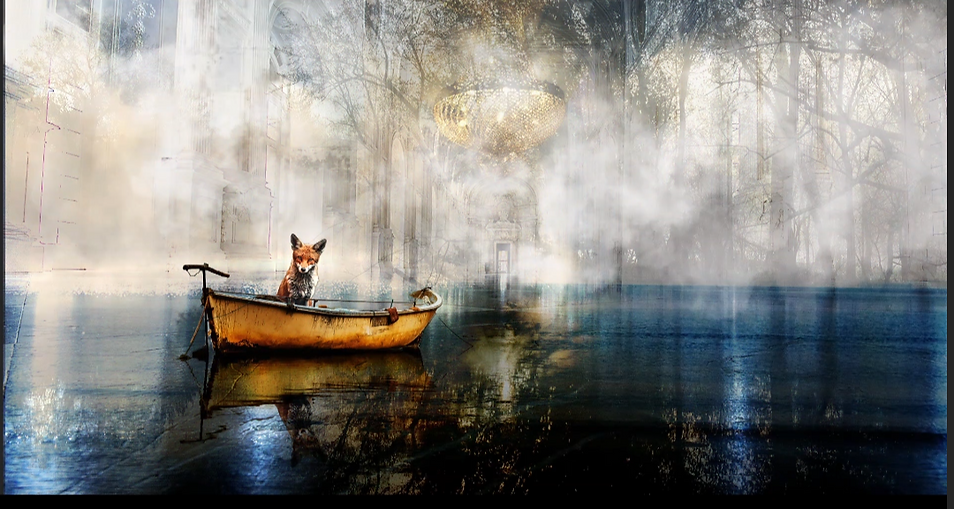
EVIDENCE 20.32
DESCRIPTION
The forest and gallery were recombined with softer contrast, allowing the architecture, trees, mist, and water to coexist.
OBSERVATIONS
-The extreme highlights and shadows from the previous version have been reduced.
-The forest now appears to grow through and around the gallery rather than simply sitting on top of it.
-The chandelier remains visible through the trees and mist.
-The central doorway reappears clearly enough to provide depth without becoming the dominant focal point.
-The fox and boat remain the strongest foreground subjects.
-The water connects all of the elements, making the conflicting environments feel like parts of the same impossible place.
-The mist helps obscure where the architecture ends and the forest begins.
INITIAL QUESTIONS
-Are the gallery and forest actually separate places?
-Is the mist hiding the boundaries between them?
-Does this place change depending on where you look?
-Is the fox traveling through the landscape, or is the landscape changing around the fox?
CLASSIFICATION
Clue
NOTE
NOTE
This was closer. I pulled back from the harsh contrast of the previous version but kept what interested me: the forest and gallery existing at the same time. I couldn’t quite tell where one ended and the other began, which felt right.

EVIDENCE 20.33 - clue

EVIDENCE 20.33
DESCRIPTION
The combined gallery and forest were darkened, increasing the contrast between the illuminated left side, the chandelier, and the shadowed water and trees.
OBSERVATIONS
-The forest becomes much more prominent, especially on the right side.
-The architecture is still visible, but it now feels partially overtaken by the trees.
-The chandelier becomes a strong pool of warm light above the center of the scene.
-The darker water creates a clearer reflection of the forest and architecture.
-The fox and boat stand out more strongly against the darker surroundings.
-The distant doorway remains visible at the center, but now feels almost hidden within the landscape.
-The scene feels less like a flooded gallery with a forest layered over it and more like one impossible environment.
INITIAL QUESTIONS
-Is the forest taking over the gallery?
-Or was the gallery always part of the forest?
-Why is the chandelier still lit?
-What is through that tiny doorway?
-Is the fox traveling toward it or away from it?
CLASSIFICATION
Clue
NOTE
Darkening everything changed the mood completely. The forest stopped feeling translucent and started feeling physically present. This was getting much closer to the strange, slightly ominous place I wanted.
EVIDENCE 19.34 - final art

EVIDENCE 20.34
DESCRIPTION
Final adjustments unified the forest, architecture, water, chandelier, boat, and fox into the completed scene.
OBSERVATIONS
-The architecture and forest now overlap so completely that neither reads as the definitive setting.
-The bright central structure and doorway create a path into the distance.
-The surrounding trees close in around that path, making the destination feel hidden and uncertain.
-The chandelier remains suspended impossibly over the water, preserving a trace of the interior space.
-The boat and fox provide the strongest warm focal point against the dark water.
-The reflections visually connect elements that should not logically occupy the same place.
-The final scene contains evidence of an ocean, a flooded interior, and a forest simultaneously.
-The fox appears to belong here despite being the least explainable part of the scene.
INITIAL QUESTIONS
-Where are we?
-Are these separate places overlapping, or one place with impossible geography?
-Where does the water lead?
-What is beyond the distant doorway?
-Does the fox know where we are?
CLASSIFICATION
Final Art / Case Resolution
NOTE
I never found a normal answer to where we were. The ocean became an interior. The interior became a forest. Eventually I stopped trying to make one of them win. The place only started working when I let all three exist at once.